Jousting with Words
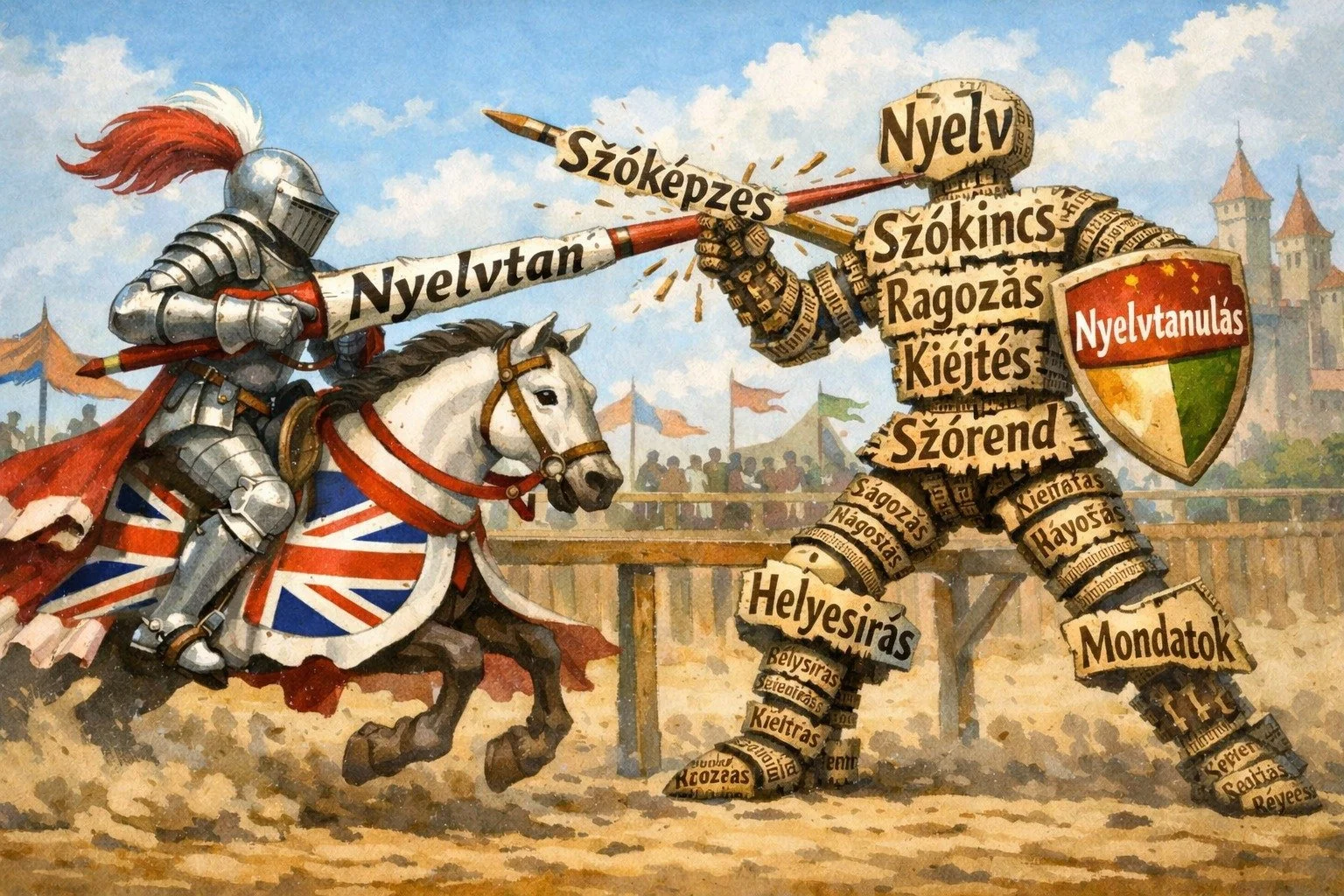
My language school is on the fourth floor of a classy nineteenth-century apartment building in the centre of Budapest. A veritable United Nations can be found crowded into the lift on their way to lessons each weekday. We migrants and exiles are the representatives of both global superpowers and marginalised countries but stand equal in this small space in a temporary truce. Taking the stairs, as I often do, I am sometimes overtaken by younger students who can reach the penultimate floor without being out of breath. Something I am incapable of! It’s four floors in a big building with 135 chunky steps to climb. As a representative of the former British Empire, I hear the pace of change behind me on the stairs. English is our medium of learning, but it is one without ownership now and subject to the whims and dialects of the overtaking lane.
Arriving this way, you get the sense of trying to storm the Hungarian language bastion even before your lesson has begun. Despite the skilled, enthusiastic teachers and solid learning materials, you know you’re in for a battle. There’s no such thing as an easy class; only a retreat from the enemy is possible. Most expats, especially Brits, give up after a course or two. This is not a joust for the faint-hearted. Like Magyar horsemen from earlier history, the language cases keep coming at you. Boxes of prefixes and suffixes that must be unpacked and examined closely to be understood in English. Sometimes the prefixes do a cheeky about-turn and hide behind verbs rather than sit in front of them! The joust is often unfair.
There are seven words for ‘to’ and six words for 'from’ in Hungarian. Location is everything. Are you going out from a flat space to an interior one? Or are you coming from across a bridge to arrive onto the railway terminal but not inside it? Stations are classified as surfaces rather than interiors. Hungarians wait ‘in’ the bus stop rather than ‘at’ it. The prefixes and suffixes will be different in every example. We simply come and go in English. The Hungarians travel with greater precision and caution.
Maybe they need to. To avoid the problem of being a small nation in the heart of a continent. Since Britain was conquered by the Normans in 1066, the country’s last invasion proper, Hungary has been occupied on eight significant occasions, as well as suffering lesser incursions after the First World War. It’s a melting pot of European civilization. Maybe 4% of current Hungarian DNA * and probably much less can be traced back to the original seven tribes who rode here from the Asian steppes. The rest is a mixture drawn from the various invading peoples and locations of ‘Greater Hungary.' Tartar, Turkish, Slavic, Romanian, Germanic, and Russian genes have infiltrated the Magyar corpus. Hungary could easily have gone the way of Ruthenia, Genoa, and other long-lost states swallowed up by bigger countries. Yet it has somehow survived. There are about fifteen million Hungarian language speakers in the world, nine million of whom are in Hungary itself. It’s a miracle that this language, transported from the depths of Asia a thousand years ago, has also survived foreign occupation and suppression. It remains as the bond that glues the nation together.
Like an invisible wall but as strong as the boundary fence with Serbia, the Magyar language protects this small embattled nation from the outside world. As I approach my classroom, I know I can battle with it but never quite win. Only the Hungarians can speak Magyar, some locals will claim, which isn’t true, but for first-tongue speakers of Indo-European languages, fluency is a mighty challenge. So much of the pronunciation and grammatical structures feel like the opposite of English. Speakers of French and German don’t find it any easier. I was surprised and impressed that the new British Ambassador arriving in Budapest spoke really good Hungarian. According to an acquaintance, his opposite number from Germany is struggling somewhat. Not that I want to make a jingoistic point here – Germans are generally stronger foreign language speakers than Brits. Let’s face it- most nations are!
One of my past teachers of Hungarian compared learning English and Hungarian to two triangles – one inverted. The English language shape has a small pointy base suggesting that students can learn the basics quickly before encountering a wider range of challenges later. Mastering illogical structures like phrasal verbs, which have shifted in meaning over time and geography as English has become the lingua franca of the world, is one way in which English becomes tougher as you climb towards a wide plateau with immense vocabulary and idioms, dialects and accents to master.
Hungarian is phonetic and claims to always be logical within its own internal structures. If it were only that simple! There are plenty of grammatical exceptions and endless language cases* to master. There are definite and indefinite forms for every verb, which I struggle to remember. One must always identify if there is an object in a sentence and react accordingly. Most sentences also have a focus which must be respected and rearranged for. In comparison to three in English, of its eighteen grammar cases**, 15 must be learnt, if not mastered at the early stage, to progress further. As a result, the triangle that represents Magyar has a broad base that one must cross many times before ascending to the possibility of having a full conversation with a local. Cracking the logic of Hungarian is sometimes like trying to solve the Da Vinci Code.
You can see, dear reader, that I’ve got my excuses for failure neatly lined up like ducks in a row. I am in the strange position of being able to describe how this language works without actually managing to speak it! Like being able to describe the tango while dancing it with two left feet! Such joy! Did I mention that there are 44 letters in the Hungarian alphabet, including 4 ‘o’s, 4 ‘u’s, 2 ‘a’s, 2 ‘e’s and 2 'i's? Or that all vowels have to be harmonised in each sentence according to their sound? No…how remiss of me!
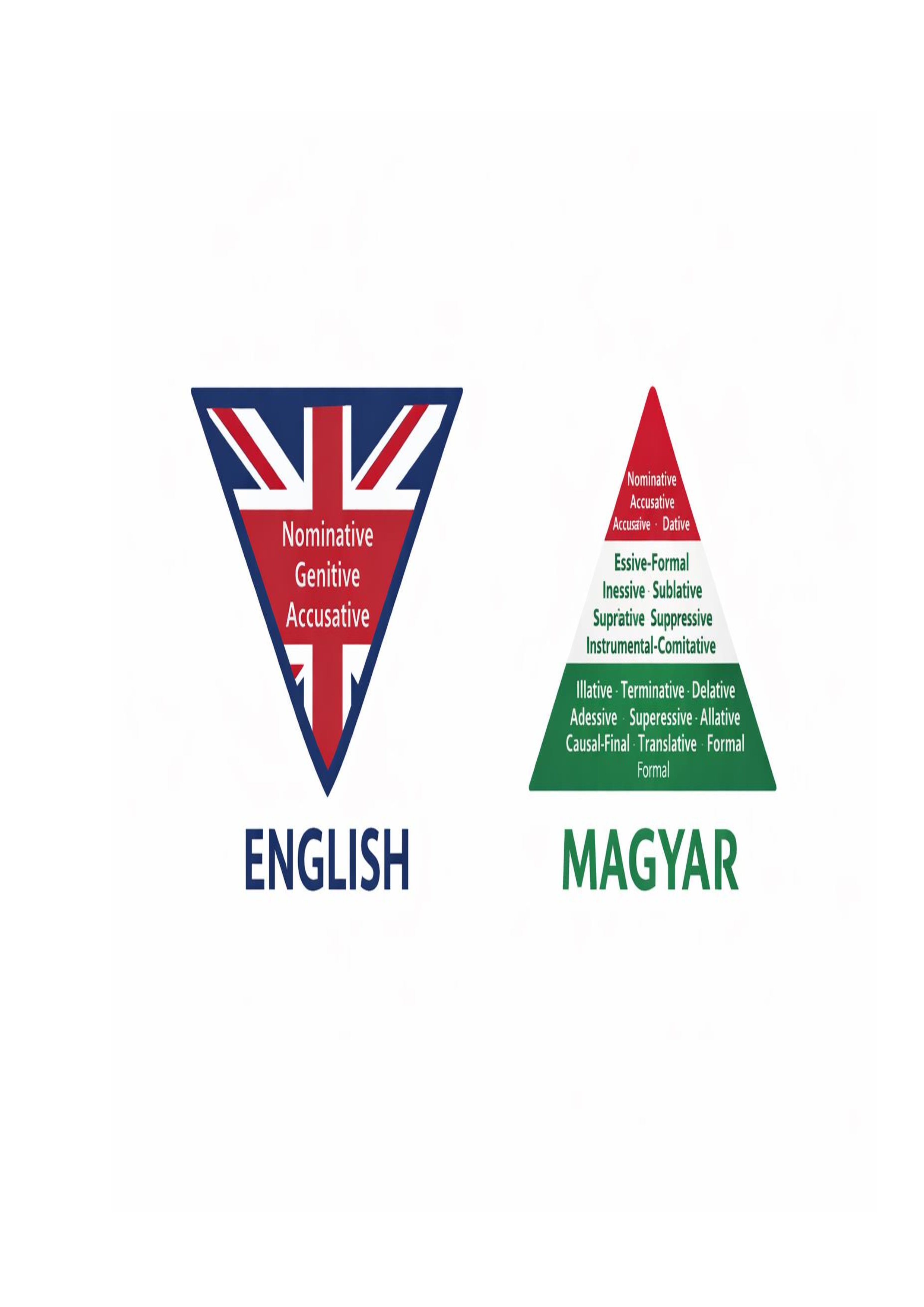
Grammatical cases are used to mark the grammatical function of words in a sentence **. In practice, they signify which alterations you have to make in a particular sentence to maintain the logic of the language. Fifteen of the Magyar cases shown, actually need to be learnt at the base of the triangle, some mastered before progressing upwards.
During my time here I have ascended those 135 steps to the language school for several courses. In late 2023 Covid terminated my ascent just before a course finished. I have tried other, less exposed, methods of learning as well, such as a language exchange and also Duolingo. Zsofi is an excellent home tutor. In truth, my Hungarian is improving-particularly reading- but at a slow pace and remains transactional at best. I can just about deal with shops, restaurants and sometimes directions. That’s about it. I only understand fragments of conversations. I will have to keep climbing those steps to be able to discuss anything in any depth. It’s an Everest-like endeavour.
I have returned to study material that I initially covered back in 2023. For once, I haven’t felt like I'm at the bottom of the class, and I finally understand some of the basics. As a perennial slow learner, this is par for my life course. By chance, last week I gave instructions in the street to lost Hungarians on two occasions. They seemed to understand me. I just hope I gave them the right directions, as they had hospital appointments to attend!
Although not a fluent speaker, J.R.R. Tolkien enjoyed Hungarian and created an unfinished language called Mágol styled on Magyar. It was one of the early languages he created, and Tolkien worked on it around the years he was writing ‘The Hobbit’ or earlier. His later and better-known Elvish languages were based on Welsh and Finnish. Maybe Hungarian confounded him as much as it baffles many modern learners?
So, why bother with a language in 2026 that Tolkien might have considered too tricky for the Shire? After all, English is the business language in the one hundred and seventy multinational companies who base a business specialism here. It’s used passively and sometimes reluctantly by Hungarians in these workplaces, only penetrating more deeply in Budapest. For native Hungarian speakers, considering the differences between the two languages, becoming fluent in English is quite a challenge too. Generally, to work for a multinational, you still need basic Hungarian to complement English and the occupational skills required.
Of course, there are other personal reasons why foreigners in Hungary strive to master the language. Coping with everyday life is obviously the main one. An intermediate level of proficiency is required for most foreigners to achieve citizenship. Not as easy to achieve as it sounds! Despite these facts, my impression is that those of us who try to storm the Mayar bastion are still the minority among the ‘külföldiek’***.The rest rely mostly on English, Chinese or Russian to survive.
Although the Habsburg monarchy destroyed all the Hungarian castles after the failed revolution in 1848, the Magyar language offers a bastion of words for those who fear the country will be swamped with foreigners as part of its EU membership. Many EU citizens shy away from a country where it takes five years to a decade to master the local tongue. The same applies for migrants, legal and illegal, from further afield. Very few of the million-plus stream of people that marched across Europe in 2015 tried to remain in Hungary. It was just a transit point before northern Europe, where colonial connections, higher wages and stronger social netting were the attraction.
The sense of a unique culture that must be protected against the outsider will feature strongly in the election on April 12th. Immersed in the EU now but once surrounded by enemies, a sense of existential threat remains in the Magyar soul. The sense that the worst possible outcome could happen again, like it has so many times in the past. My teacher tells me that we learn languages by remembering patterns rather than rules. It’s true in a different sense too. Pattern recognition in Hungarian history will reveal many defeats. A blueprint of mistrust has been stamped on the Hungarian psyche by the disasters of the twentieth century. Just as memories of the British Empire still weave nostalgic fantasies across the politics of the UK, deeply ingrained cynicism towards anything progressive, egalitarian or liberal is the prevalent motif here.
The incumbent in the forthcoming election speaks of bad influences from the West. The other main candidate is also a conservative but wary of capitulation to the Near East. I simplify the contest here, of course. Economic issues notwithstanding and very much present in the debate, that politician who offers a sense of security against an alien world, however defined, will probably be the election winner. Meanwhile, I’ll keep climbing those chunky steps four afternoons a week and continue to joust in the citadel. Luckily, kind teachers are lowering scaffolding to assist my progress, and so far, not a drop of boiling oil has fallen on my weary shoulders.
*Maróti et al. (2022): Published in Current Biology,
** Carol H. Rounds Hungarian- An Essential Grammar- Routledge
*** külföldiek- means foreigners.
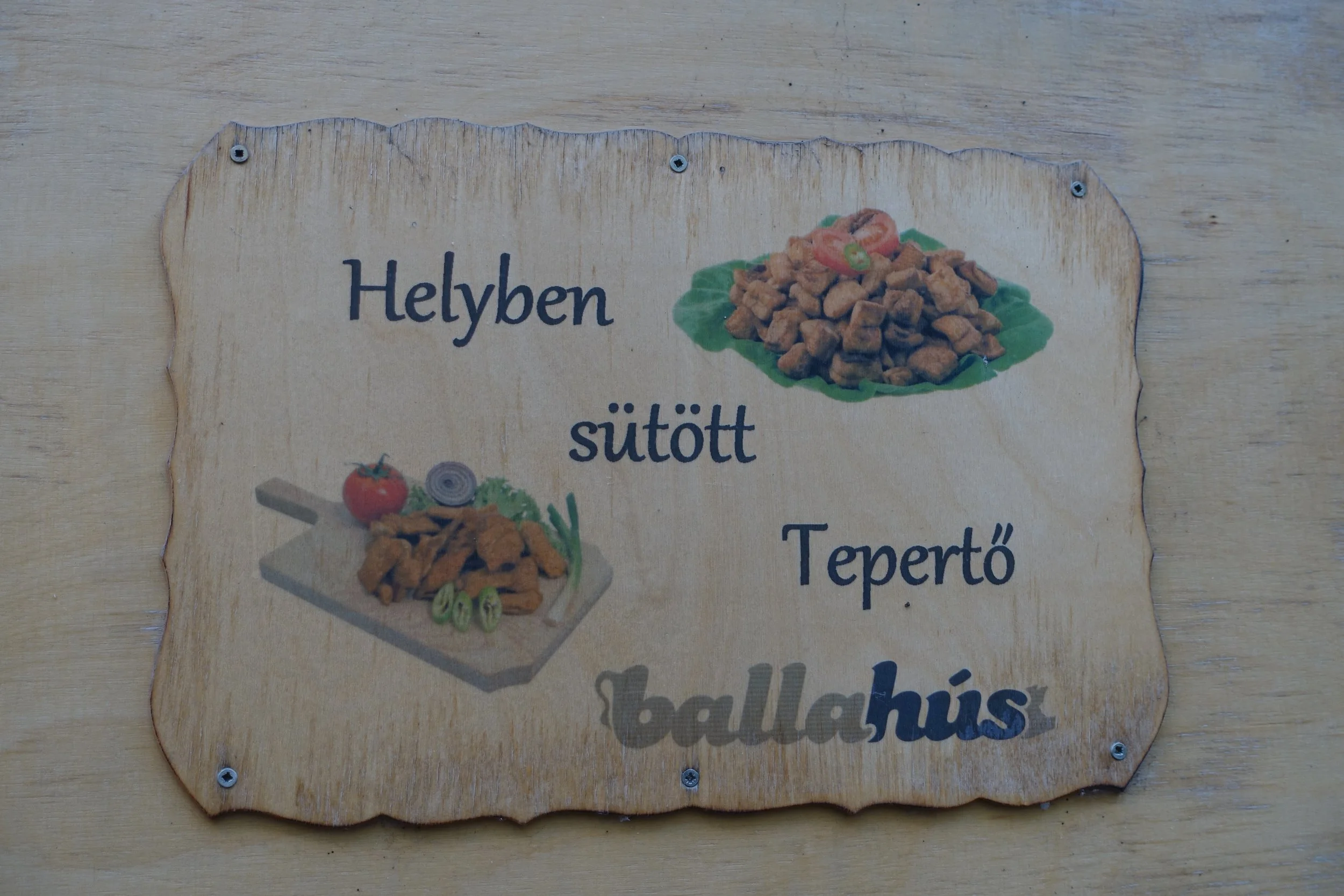
Advert outside take-away restaurant reads-’In this place- baked pork scratchings.’
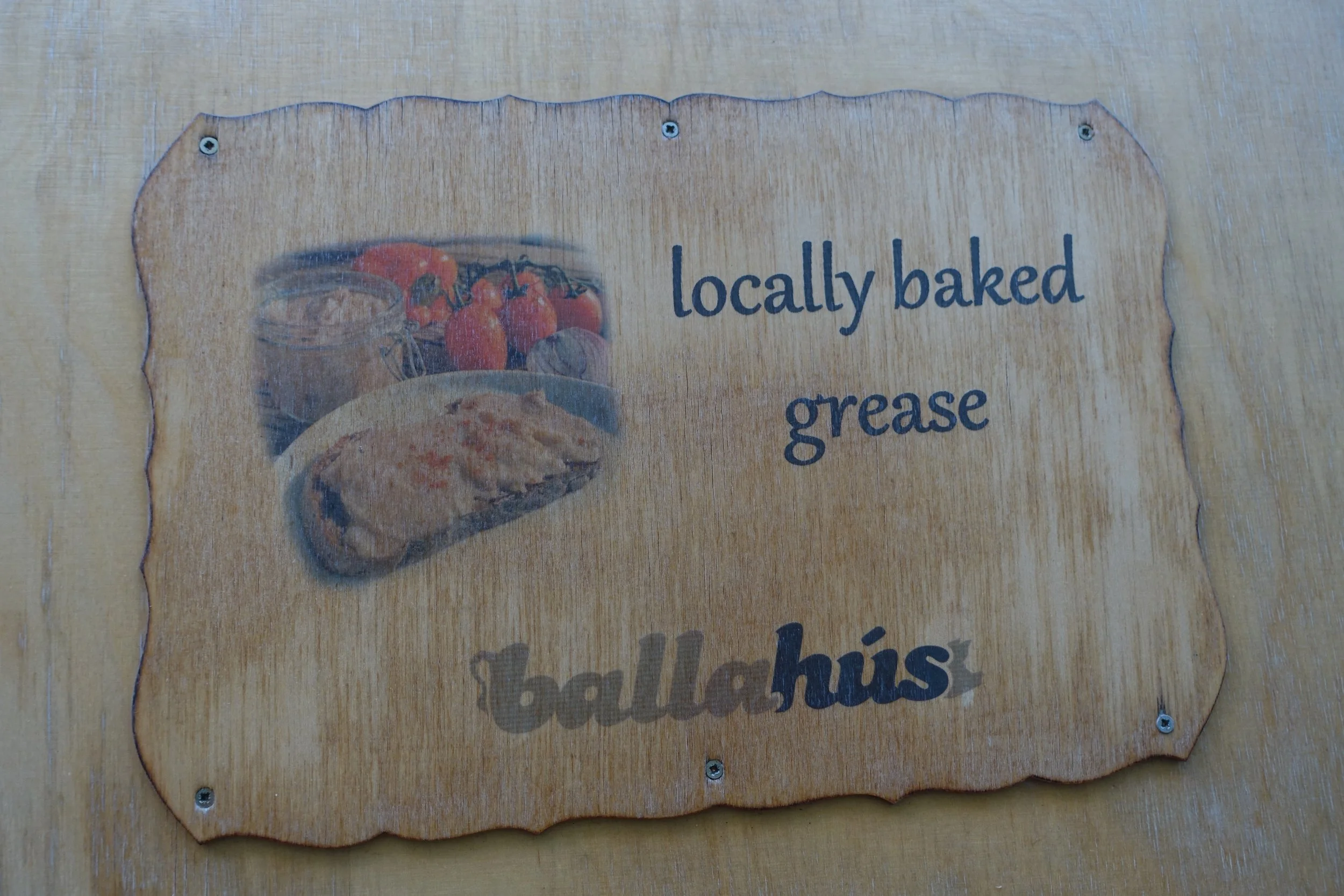
Lost in translation?