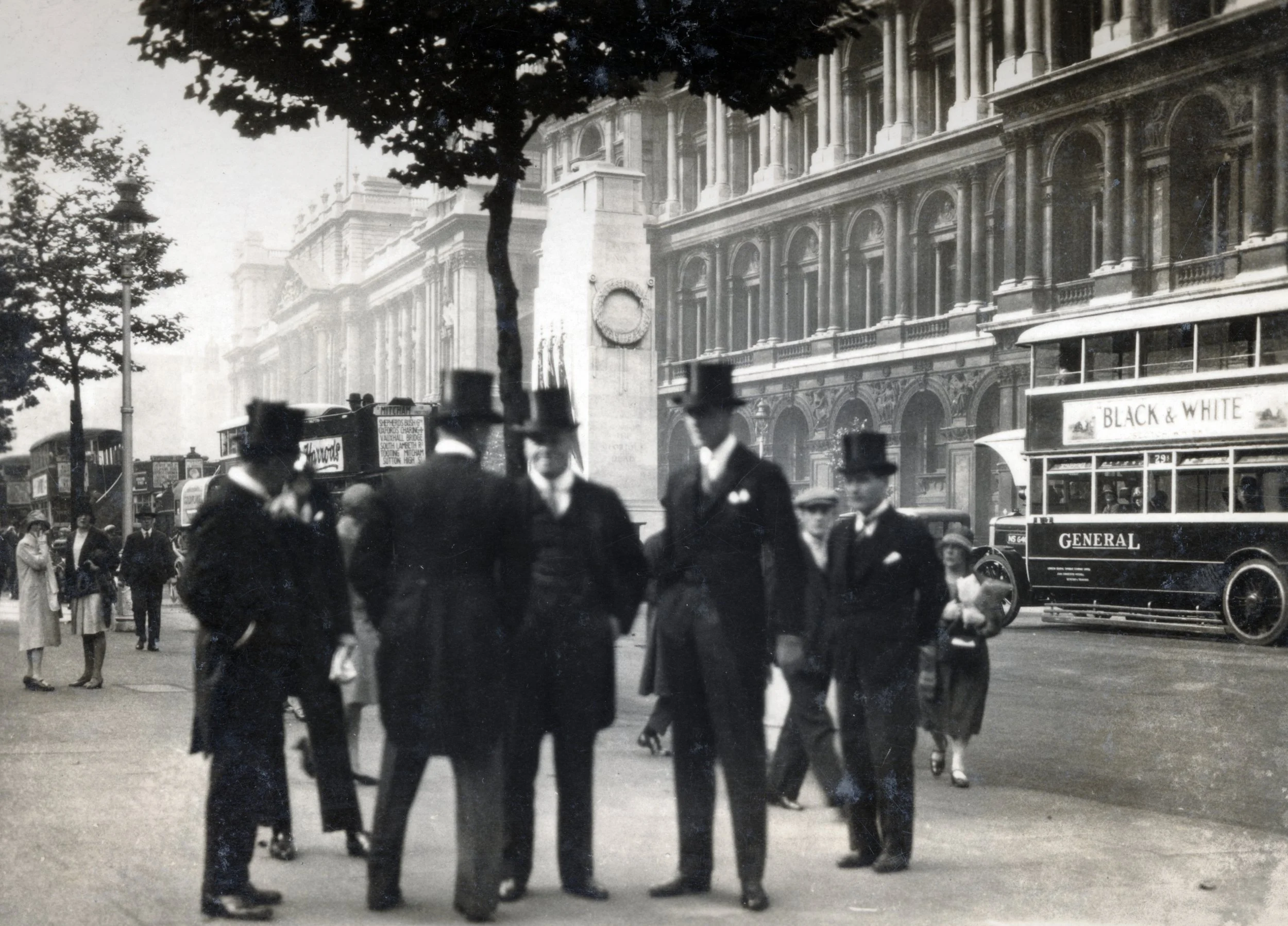
1929 - Viscount Rothermere and son Esmond Harmsworth at the Cenotaph in London. They are in the centre of the picture facing the camera. Photo courtesy of Fortepan/Abraham Katalin es László.
Most Hungarians today have forgotten the name of Viscount Rothermere, and that this British newspaper tycoon was enormously popular here during the 1920s and the 1930’s. Some even wanted him to become the King of Hungary. Through his ownership of the Daily Mail, Daily Mirror and other titles, he became one of the richest and most influential men in the UK. When he championed the case for a revision of the Trianon peace settlement of 1920, he was a rare voice in western Europe willing to support the Hungarian cause.
After his Daily Mail article entitled ‘Hungary's Place in the Sun’ was published on 1st June 1927, the Magyar nation was delighted to find a prominent supporter. As a result of the Trianon settlement, Hungary had ceded approximately 71% of its territory and 64% of its population to neighbouring countries. This created enormous bitterness among the Magyar people and left a feeling that President Wilson’s principles of self-determination, which shaped the post-war peace settlements, hadn’t been applied to this thousand-year-old nation. The ‘winners’ were those countries that had fought on the Triple Entente side during WW1 and which were rewarded with expanded territories or nationhood for the first time. In his article, Rothermere called for a plebiscite through which the displaced Hungarians could vote on which country their towns and villages would be governed by. Only one had been held following the peace settlement: that on a regional basis in 1921, whereby the people of western Hungary voted to remain as Magyars rather than become citizens of Austria.
Through further articles, Rothermere focused on the details of the newly established borders. In the case of Slovakia, he wrote* that a million Hungarians had been left behind in the border area close to Bratislava, known then, as it is today, as Pozsony by the Magyar nation. That was probably an exaggerated number but the 2010 census showed approximately 30 per cent of the population was Hungarian-speaking, while just under 58 per cent spoke Slovak. Germans and Ruthenians accounted for a further 10 per cent or so. Although Slovakia had a clear Slovak majority, nearly one person in three was Hungarian.**
A further six hundred thousand Hungarians were left in the area just behind the newly established Romanian border, mostly living in towns and cities which had been over 90% Magyar before the First World War and for many centuries earlier. Rothermere also understood the complexity of Transylvania, where Hungarians (about a million), Romanians and Saxons had lived in close proximity for many centuries. He recognised the difficulty of finding an equitable way forward in terms of ‘self-determination’. Another substantial contingent were the 400,000 Hungarians living in the newly enlarged Yugoslavia, mostly in Serbia.
Overall, 3.3 million ethnic Hungarians found themselves living outside the former borders. Rothermere thought the Trianon settlement was unjust and that Hungary represented a ‘powder magazine’ in the centre of Europe.* He also believed that Czechoslovakia was another potential explosion point, as the Versailles settlement had left three million ethnic Germans behind the newly established Czech border.
Once Rothermere’s article was published in the Daily Mail, it attracted huge attention from the Hungarian diaspora and back at home. The UK public were more concerned with a declining economy and falling living standards. His article didn’t register loudly with the British people, who knew little of life beyond the Rhineland. Britain was left impoverished after World War One. Organised labour was raising its head powerfully across the country, and a strong middle class had already emerged. The privileged British aristocracy, including Rothermere, feared that they were being undermined from within and threatened by Soviet Bolshevism from beyond.
In Hungary, most politicians and members of the public were delighted by Rothermere’s 1927 article and rushed to applaud its writer. Rothermere described what happened in his short book, ‘My Campaign for Hungary’, published in 1939*. He describes the huge amount of mail he received, so much so that he had to employ two secretaries for several years to deal with the correspondence. He received over a million letters written in Hungarian.
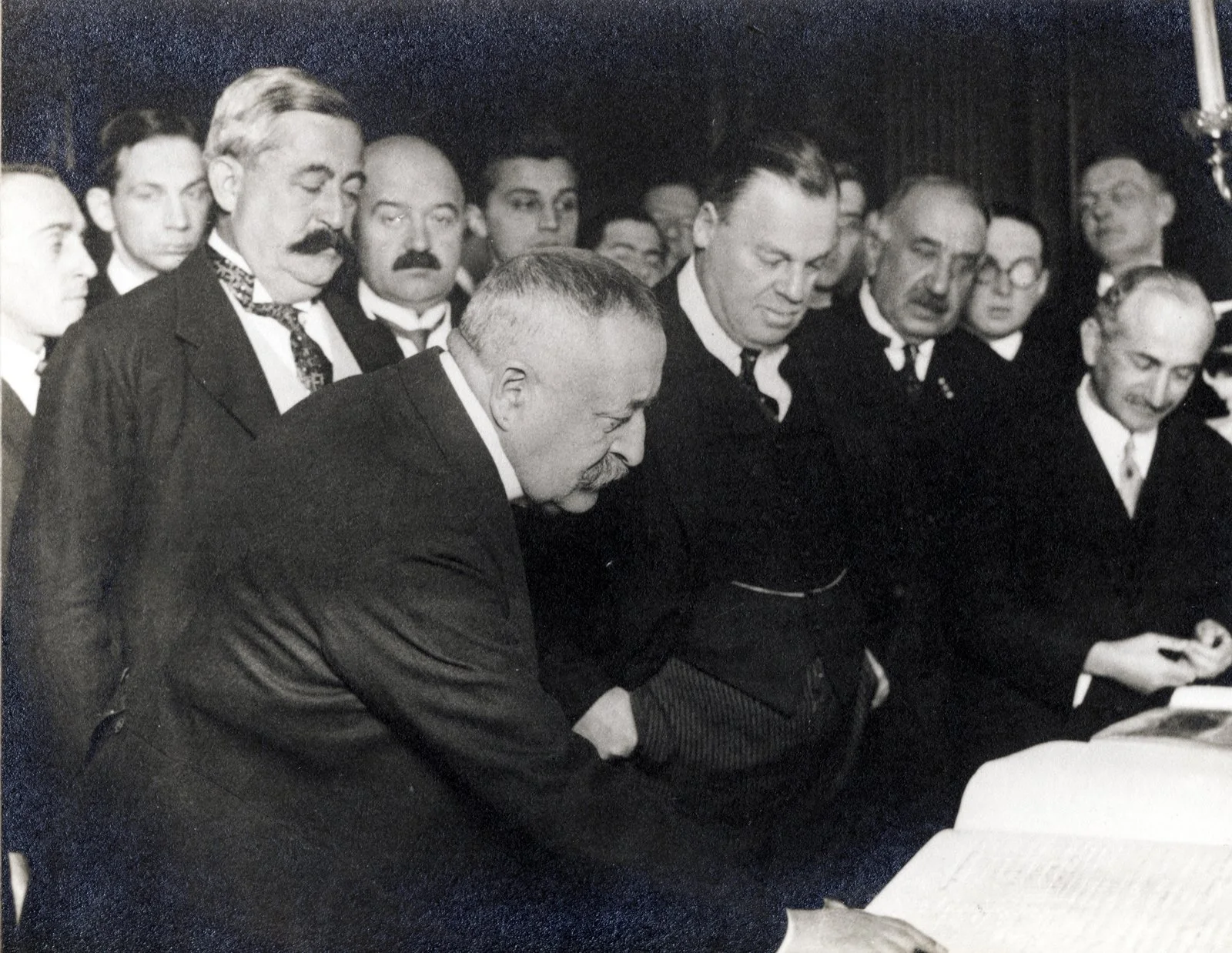
1927 Viscount Rothermere (centre) at Warwick House, London receiving a Hungarian delegation. Photo courtesy of Fortepan / Mátyásfalvi János
Later in 1927, Rothermere visited Hungary for the first time. It was an impromptu visit, made while he was staying in Vienna. He learned about the high national suicide rate, with fifty people a month jumping off bridges in Budapest alone, and saw the cafés and nightspots full of wealthy foreigners enjoying the low costs of a dismembered nation. He saw the living conditions of thousands of refugees who had escaped from the former Hungarian lands, many living in railway carriages and camps. Rothermere met previously upper-class residents forced to work in shops or in other mundane occupations as the economy struggled.
His son’s visit in May 1928 was more like a state visit by a reigning premier. Esmond travelled to accept an honorary law degree from the University of Szeged on behalf of his father and to receive the nation's formal expressions of gratitude. Upon arriving in the capital on 16th May, he was greeted by crowds estimated at half a million people. He was entertained at the highest levels of government, and a hundred thousand people waited outside the Gellért Hotel in central Budapest for his arrival at a reception. Esmond attended high Mass in the Matthias Church and had lunch with the Regent Horthy and his wife. In honour of Esmond’s visit, Blackburn Rovers had been invited to play a commemorative match against a Hungarian eleven in the capital. They lost three goals to two.
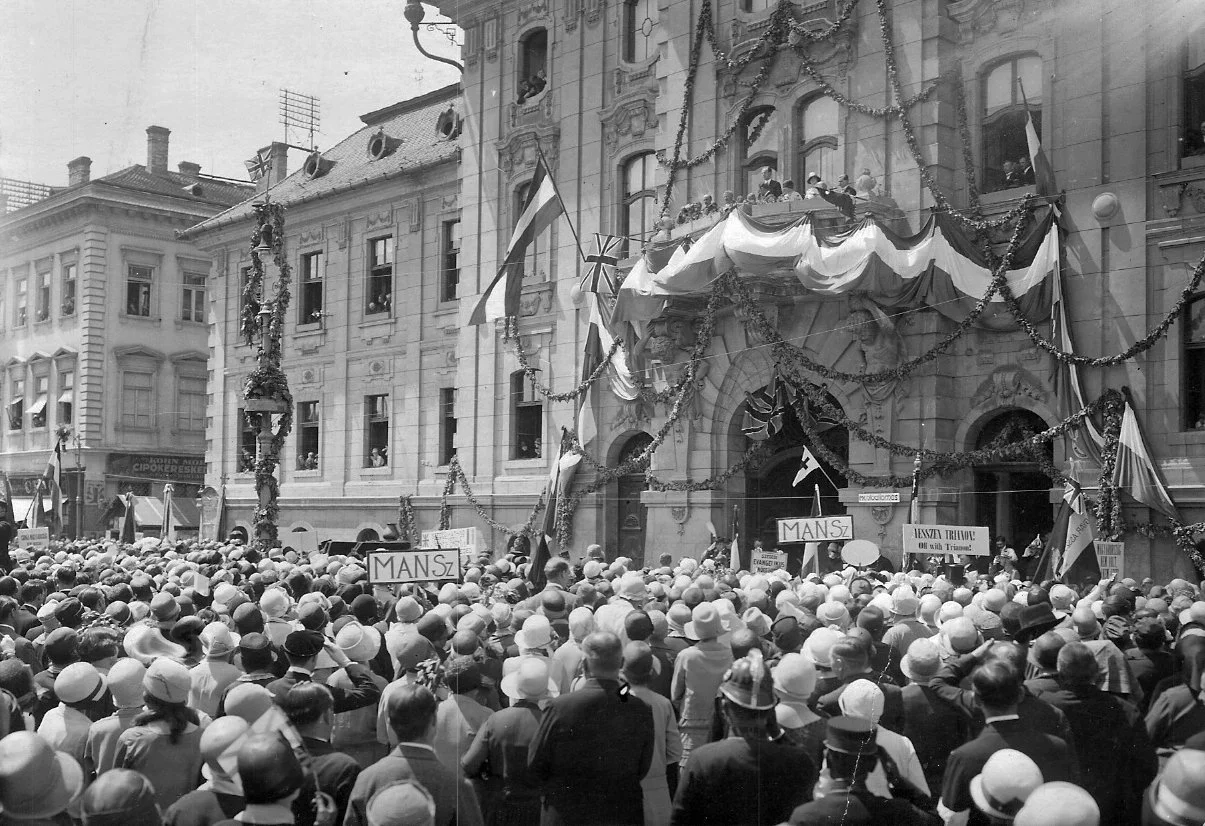
1928 Rothermere’s son, Esmond, at Szeged Town Hall addressing an enthusiastic crowd. He is the figure standing on the balcony. Photo courtesy of Fortepan/Fődi Gábor
During the years that followed, delegations of Hungarians visited Rothermere in London. With the defeat of the Austro-Hungarian Empire in WW1, a Habsburg monarchy was forbidden to exist by the Western powers. Such a reinstatement would also have attracted an invasion from the highly armed Little Entente (Romania, Czechoslovakia and Yugoslavia). Hungary was allowed an army of only thirty-six thousand men, and Horthy and the government understood that the days of Habsburg royalty were truly over.
One solution, initially put forward by a group of army officers, was that, as a non-Habsburg or Austro-Hungarian, Rothermere could become King instead. They visited London to make the proposal. Influential journalists and monarchists took up the cause. The movement was spearheaded by prominent figures like Jenő Rákosi, an influential conservative newspaper editor. Some of the monarchists thought that, after his triumphant visit, Rothermere’s son Esmond might become King instead. Rothermere and Esmond politely declined these offers in 1928. Rothermere said that the Hungarians should choose one of their own people for the title.
After maintaining his views about Trianon for a decade, Rothermere’s final visit to Hungary was in 1938, after Hitler and Mussolini had enabled some of Slovakia to be returned to Hungary. Rothermere writes almost ecstatically about his time in Kassa (now Košice) in his book*, describing his visit as the culmination of his Campaign for Hungary. He seemed as overcome with emotion as the Hungarians, who had been resident there for a thousand years. These territories were returned to Slovakia in 1947 by the emergent Hungarian communist regime.
Rothermere didn’t visualise the terrible price Hungary would pay for Nazi support later during World War Two, in terms of civilian deaths at home and troops lost on the Eastern Front. Approximately 550,000–565,000 Hungarian Jews were murdered during the Holocaust, including those living in territories that had been part of Hungary before the 1920 Treaty of Trianon.
There isn’t enough space here to describe Rothermere’s developing relationship with Mussolini and Hitler during the 1930s. Suffice to say that he admired both men and was pleased when Germany captured the Sudetenland of Czechoslovakia in October 1938. Less than six months later, Hitler broke the Munich Agreement, sending German troops to invade and occupy the remaining Czech provinces of Bohemia and Moravia. Slovakia declared independence as a German client state. Rothermere’s belief in Hitler was shattered by the Führer’s decision to march on Prague, a city which had never been part of Germany. Following that, his Daily Mail editorials called for rapid British rearmament, although he had actually promoted this idea as early as 1935. A complex man, holding contradictory views at times, Rothermere died in November 1940 in Bermuda.
One question that readers might find interesting concerns how and why Rothermere became interested in Hungary in the first place, particularly at a time when there was plenty happening in the UK to fill his newspaper columns. The answer lies in his romantic and ongoing political relationship with Stephanie von Hohenlohe, the Austrian princess who moved to Paris and then London from 1932. During and after their intimate relationship, Rothermere paid her a retainer of £5,000 per year to feed back information from the German High Command. Von Hohenlohe enjoyed romantic relationships with Hitler’s military officers and a close one with the Führer. Rothermere believed his former mistress, of middle-class Jewish origin, could help influence events in Germany. The Nazis believed that she could do a similar job for them in Britain! As well as Rothermere, von Hohenlohe was on good terms with the Prince of Wales and future King, Edward VIII, his lover Wallis Simpson and Lady Snowden. She was close to the spouses of most prominent British Cabinet ministers. Von Hohenlohe ended up being closely monitored by British, French and American intelligence agencies. An MI5 report described her as the only woman who could influence Hitler. She is reputed to have persuaded him to invade the Sudetenland. A later CIA report described von Hohenlohe as a worse threat than ten thousand men.
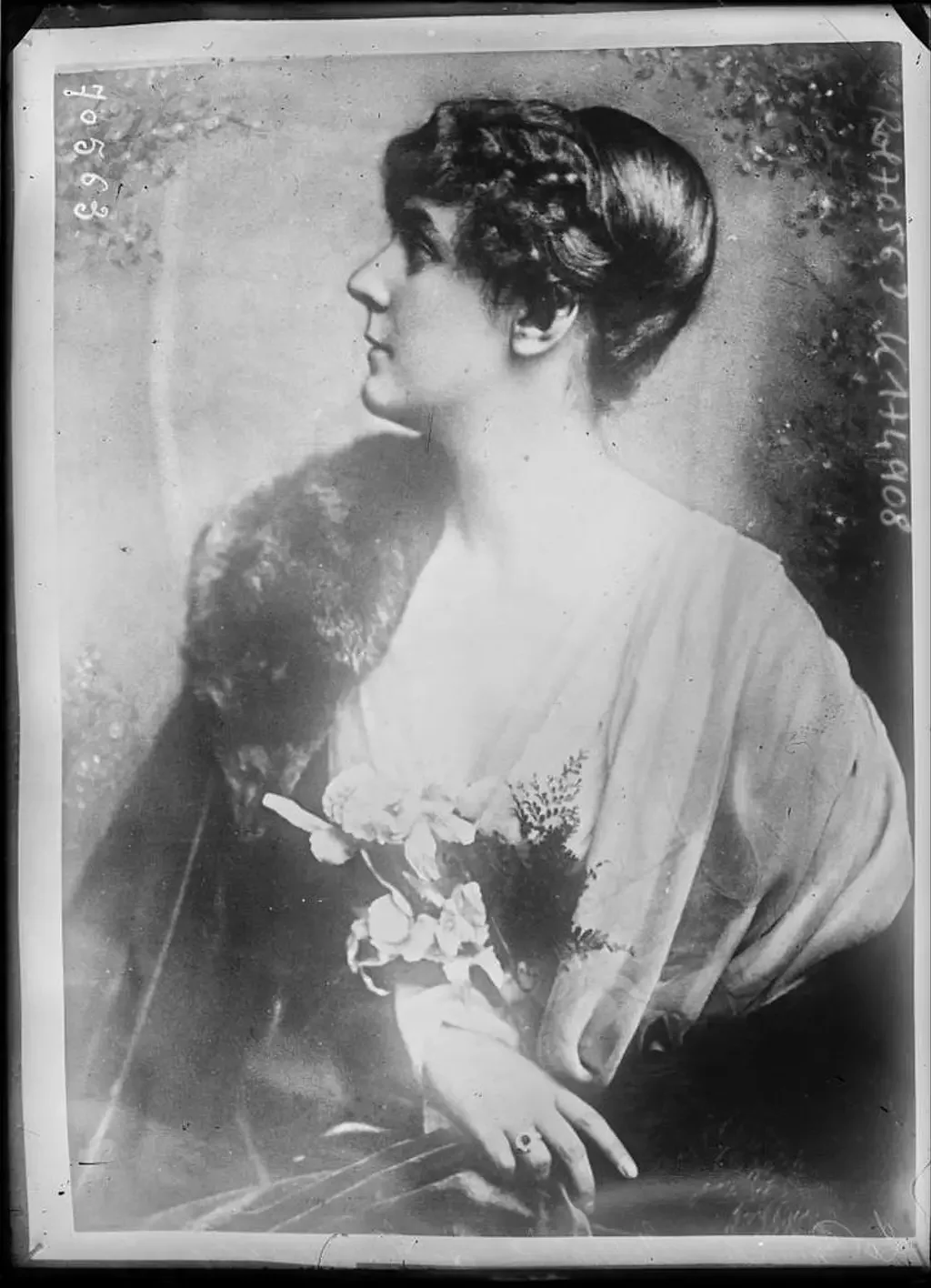
Stephanie von Hohenlohe photographed by the press in December 1921 -http://commons.wikimedia.org/ Status-public domain.
As war approached, she could no longer play for both sides, and the Nazi Party in Germany increasingly discussed her Jewish origins. Rothermere no longer found her useful and cancelled his £5,000-a-year retainer (over £200,000 in today’s money). In reply, she took the newspaper magnate to court, claiming breach of contract. At the trial, von Hohenlohe claimed that when they first met in 1926, Rothermere didn’t know the difference between Budapest and Bucharest.(1) Whether that is true or not, it does suggest that this daughter of the Habsburg Empire was a key inspiration behind his interest in Hungarian politics. She lost the court case and had to pay costs to Rothermere. Continuing her adventures in America after the war and living a long and eventful life, Stephanie von Hohenlohe is regarded as one of the most intriguing figures in 1930s political espionage.
The statue erected in 1928 near Kálvin tér in Rothermere’s honour still stands today, with his bronze bas-relief portrait clearly visible. In the 1920s, towns and cities across Hungary named streets after the English Viscount. There were five in Budapest alone, including what is currently Balaton utca, close to the Parliament building. The widespread naming was a remarkable recognition of his popularity, considering that he wasn’t even a Hungarian statesman!
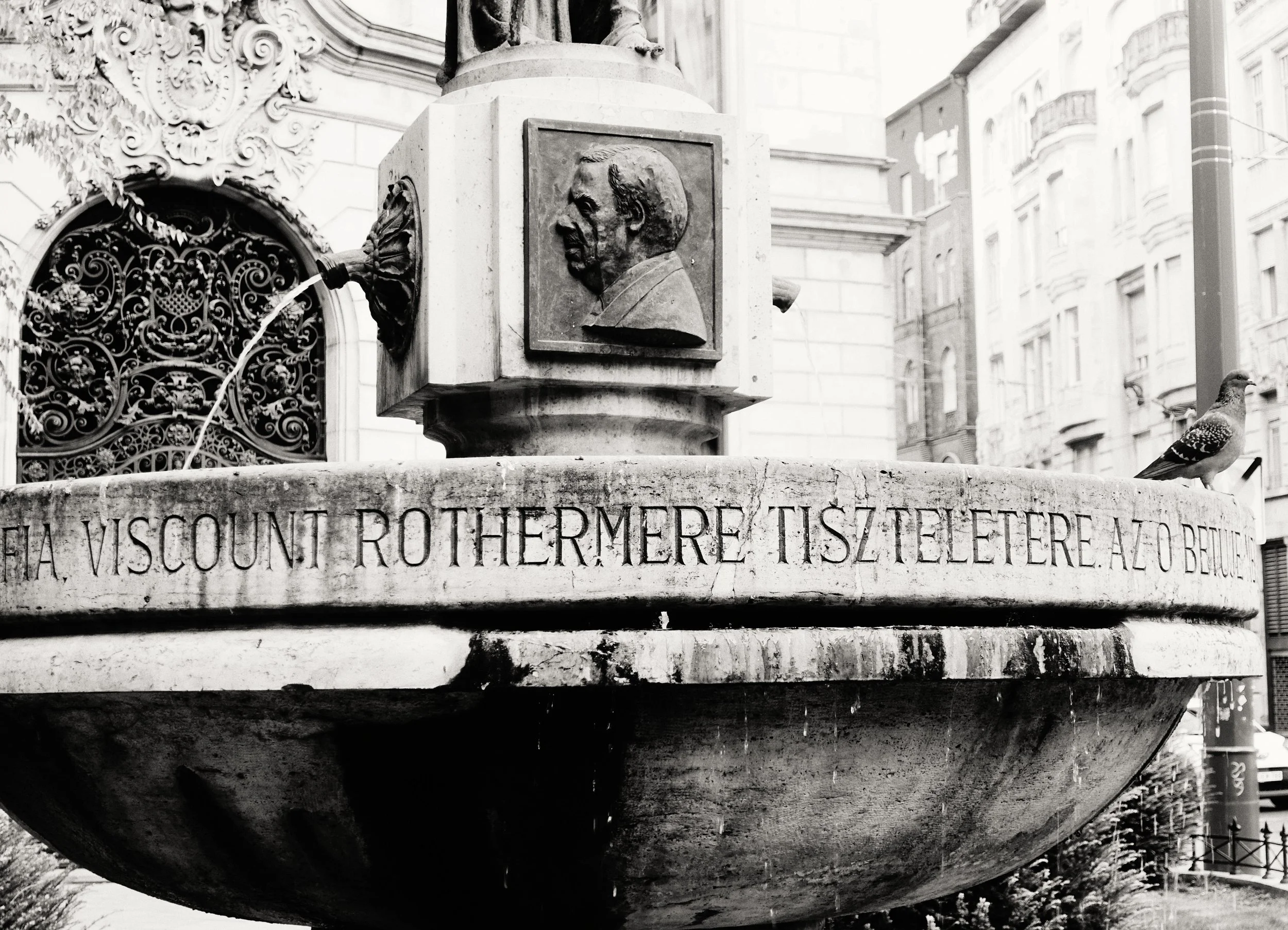
Statue erected in 1928 near Kálvin tér, Budapest in honour of Viscount Rothermere.
During the communist period, all of these street names were changed, although his statue was left untouched. Its fountain still flows during the summer months. Rothermere is a forgotten foreigner, but memories of Greater Hungary echo loudly. Weather reports from state media still call the lost cities by their Hungarian names. For example, Bratislava is always called Pozsony, and Cluj-Napoca in modern-day Romania remains Kolozsvár. While the populations of the areas concerned have become less Hungarian over the decades, 1.7–1.8 million ethnic Hungarians still reside in the lost territories. Trianon remains the ugliest foreign word inserted into Hungarian history and the borders introduced in 1920 remain. Like the Hungarians, the ghost of Rothermere would be disappointed with the way things have turned out.
*My Campaign for Hungary- Viscount Rothermere 1939
**Hungarian census 2010. The Czechoslovakian census of 2021, taken after the Trianon settlement, suggested the number of Hungarians had dropped to about 22%, reflecting population movement and other factors.
(1) As recorded in Time Magazine November 20 1939