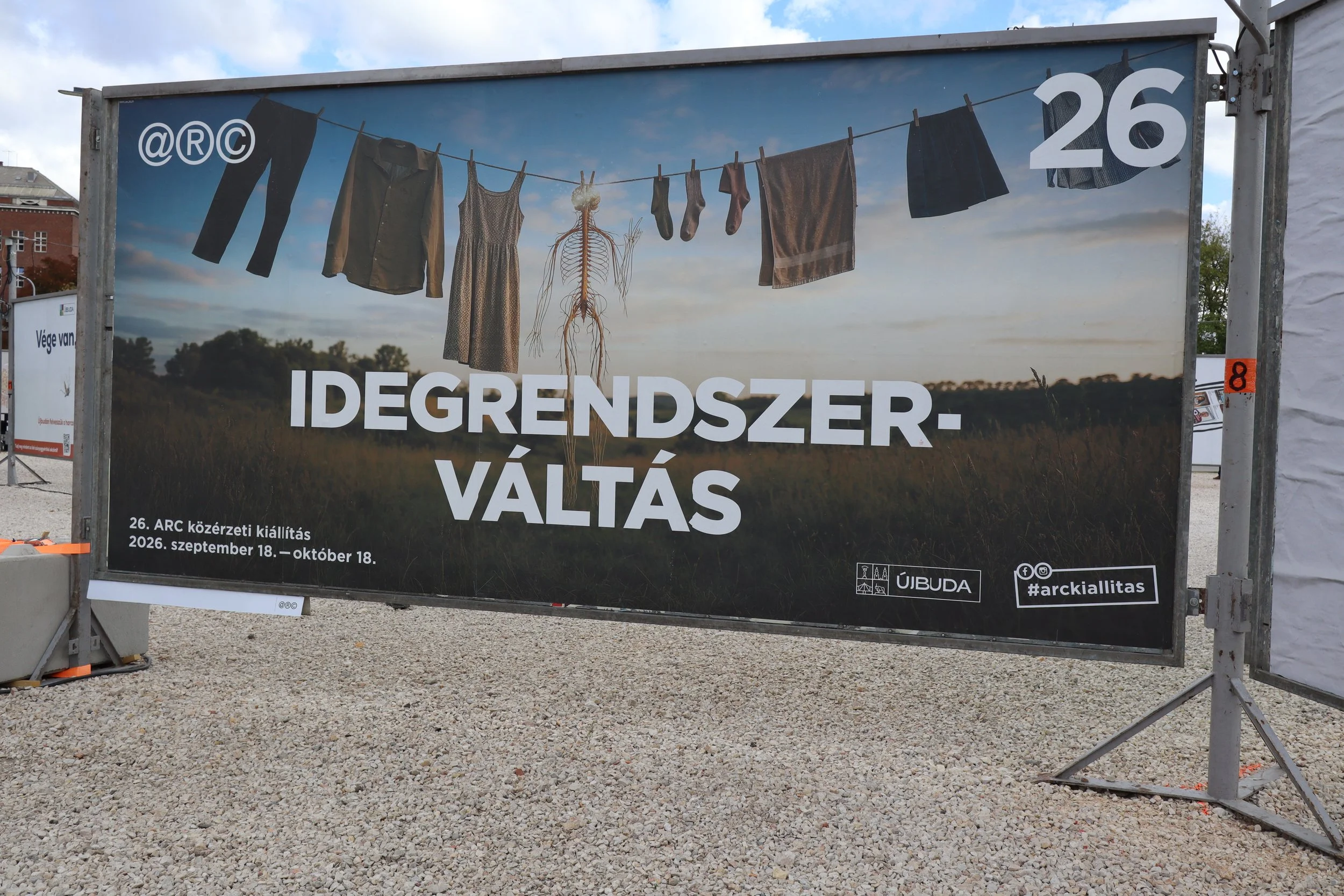
‘Nervous System Change’- the title of the 2026 ARC poster competition and exhibition.
I had heard that the annual ARC magazine* poster competition creates one of the country’s most interesting exhibitions each year. The idea is to give ordinary people a public platform to express their opinions about Hungarian society, politics and everyday life through creative, often humorous and provocative poster art.
Previously held in a park on the edge of the city in early autumn, I had yet to attend. The exhibition has been running since 2000, but this year it was moved to a university car park closer to the centre, so I thought I would go along. It’s free to visit and runs for a month. This year’s theme was ‘Nervous System Change’.
Here is part of the brief, which entrants were asked to consider:
‘Hello! How are you? Are you relaxing? Or are you still nervous? Are you trying to let go, but it still takes time? Even if it happens slowly, the stomach cramps are easing, and maybe the change will really be radical. In the meantime, it’s worth reprogramming our reflexes and rewiring our nerves. You can also unpack the suitcase you’ve packed, and you can delete those saved job opportunities abroad. And, most of all, you should learn to smile from the heart again.’
The above obviously relates to April’s election result, but it was also open to other interpretations. In fact, entrants can select whatever topic they like. Climate change, AI and other broader issues in Hungarian life were all represented among the selected entries.
The ARC exhibition has come to be seen as a barometer of the nation’s thinking on topical issues. This year, there were over nine hundred entries, of which ninety were selected for display, twenty-four hours a day, in the rather bleak, gravelly space near Petőfi Bridge and the BME university buildings.
There was a lot to take in, and many posters referred to specific details of Hungarian life which I don’t know enough about to comment on, such as lesser-known politicians, film stars and television personalities. Some posters conveyed crude political messages, which I’m sure have been a feature throughout ARC’s history and will remain despite the new governmental leadership of Péter Magyar.
I had one initial thought, that Viktor Orbán survived for so long partly because he allowed such visual criticism to continue. It was a safety valve for dissent at a time when the media was being manipulated so dramatically. Like Hogarth’s cartoons or Spitting Image in the UK, humour can take the sting out of a situation without necessarily providing a real antidote. Of course, safety valves don’t always work, and popular negative portrayals of Marie Antoinette for example, didn’t help her cause at all in 1789.
At the exhibition, I found much to enjoy, and I’ve included the ‘official’ ARC winner and some of my favourites below. The competition is free to enter. Art for the people, perhaps? Whether ARC offers a true barometer of Hungarian opinion, I couldn’t really say. Viktor Orbán received over two million votes in the election he lost in 2026 after winning two supermajorities in previous elections. What do those Orbán voters think now about the state of play in their homeland? Left-wing voters, by and large, ‘lent’ their votes to Magyar to bring the Orbán era to an end. They have no representation at all in the current parliament, but I think their views are better represented at the ARC exhibition than those of Fidesz voters.
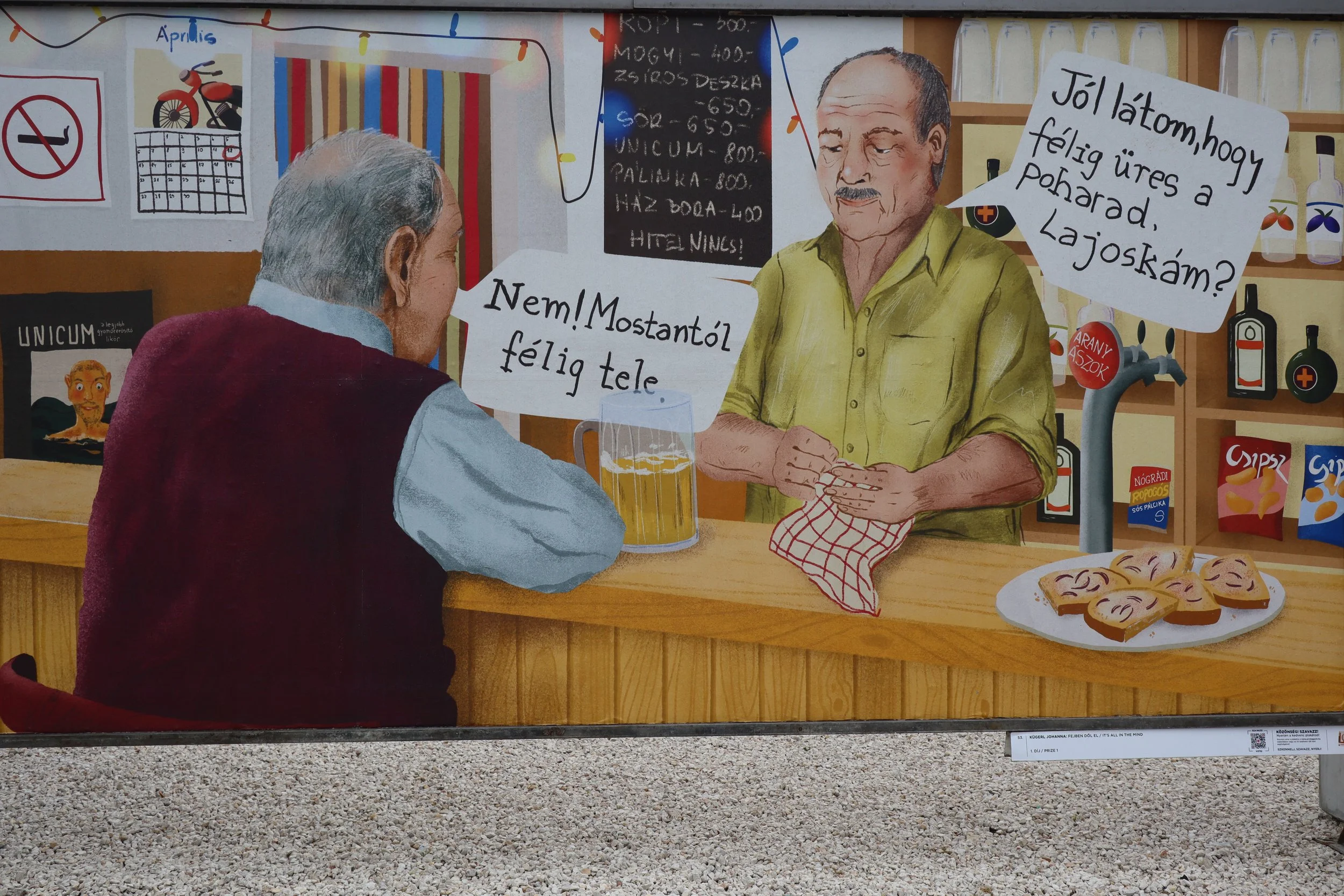
‘Do I see correctly that your glass is half empty, Lajos?’ ‘No! From now on it’s half full!’ Poster entitled: It’s All in the Mind’ by Johanna Küg- First Prize winning entry.
The drinker above is clearly referring to the election result and making an ironic reference to the fact that Hungary is enjoying a wave of optimism when, perhaps, things are just the same. The kocsma (pub) is well drawn (not that I know about such places!), although the prices on the board behind the barman seem a little low by 2026 standards. Unless this bar is supposed to be somewhere in the back of beyond, where nobody can afford Budapest rates?
As an aside, but a relevant one, I was struck by how reasonable Lidl in the UK felt in terms of prices compared with supermarkets in Hungary. It was hardly a scientific survey, but food prices here seem to be higher than in the UK, while wages are substantially lower. It’s no wonder you see people buying three radishes, a tomato and a carrot, or some similar combination. When it comes to eating out, alcohol, tobacco and energy prices, the UK is clearly more expensive. Not to mention the cost of train travel, which is borderline criminal in Britain and excellent value in Hungary. Provided the train arrives, of course! Which is not always guaranteed on some lines.
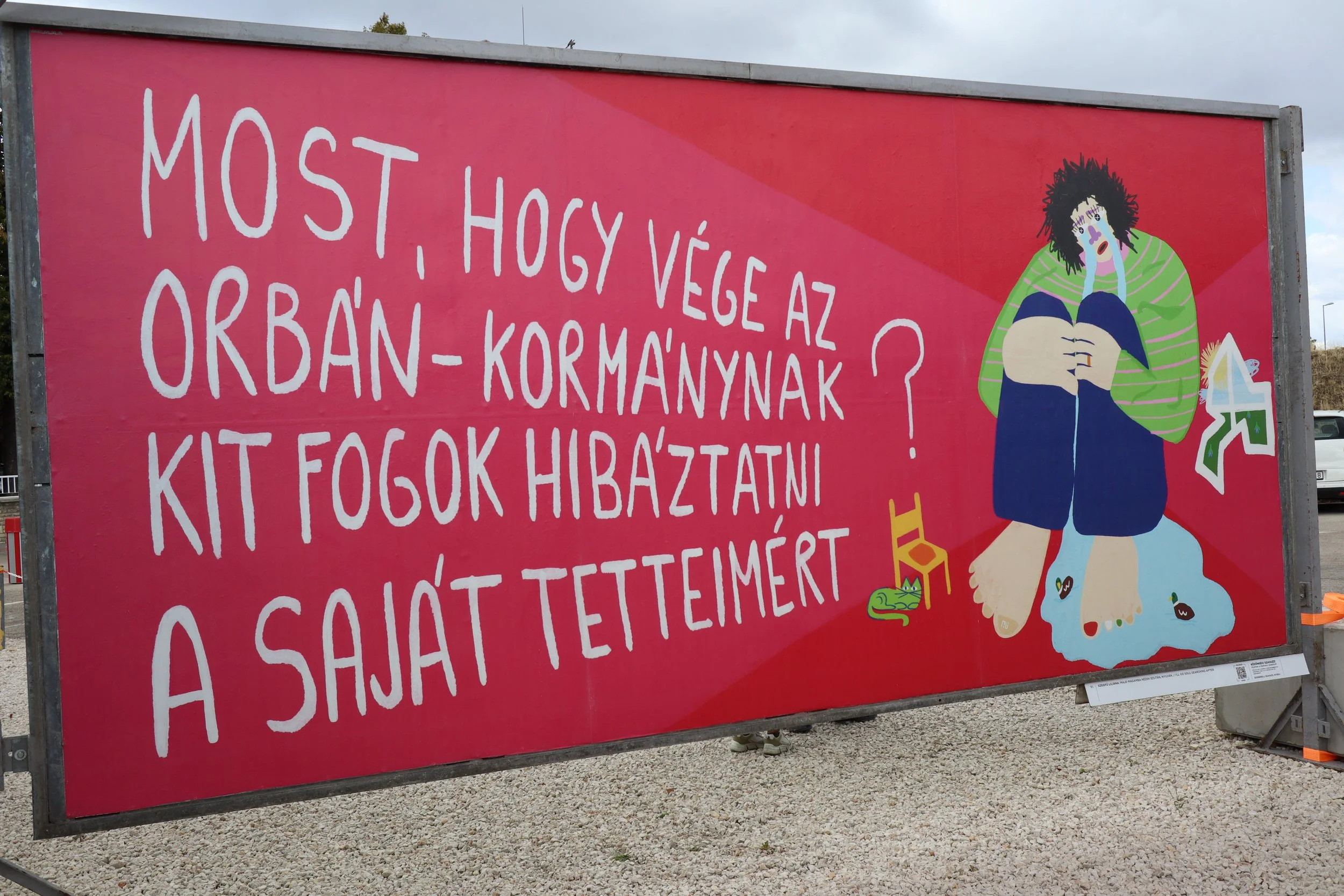
‘Now that the Orban government is over, who am I to blame for my own actions?’ Poster entitled: '‘ I’ll Go Soul-Searching After’ Liliána Szegfű’
Liliána Szegfű’s entry is a poignant little reminder that we all blame others for things we do, whether on a personal, occupational or political level.
The feeling in Hungary at the moment is something like that experienced in Britain after the Conservative government left office in 1997. There was a sense that everything should improve after a period of moral decline. Probably the same was true in 2024? In contrast, the Labour Party seems to leave office mostly after economic failure, accompanied by accusations of incompetence.
The sleaze accompanying John Major and the chaos associated with Boris Johnson and those who came after him are mirrored in people’s opinions in Hungary at present. As Labour declared in 1997, ‘Things Can Only Get Better!’ Or can they? asks the pessimist, wherever they happen to be in Europe.
Of course, what happens to any individual is subject to a range of different factors, with politics normally being only one of them. This poster offers a warning to the citizens of Hungary: we all have to take responsibility for our actions. Political leaders can sometimes become bogeymen or bogeywomen whom we blame for things outside their control. We all have our own agency in life — don’t we? How long will it be before Péter Magyar’s government gets blamed for everything that goes wrong in people’s lives? It’s probably started already.
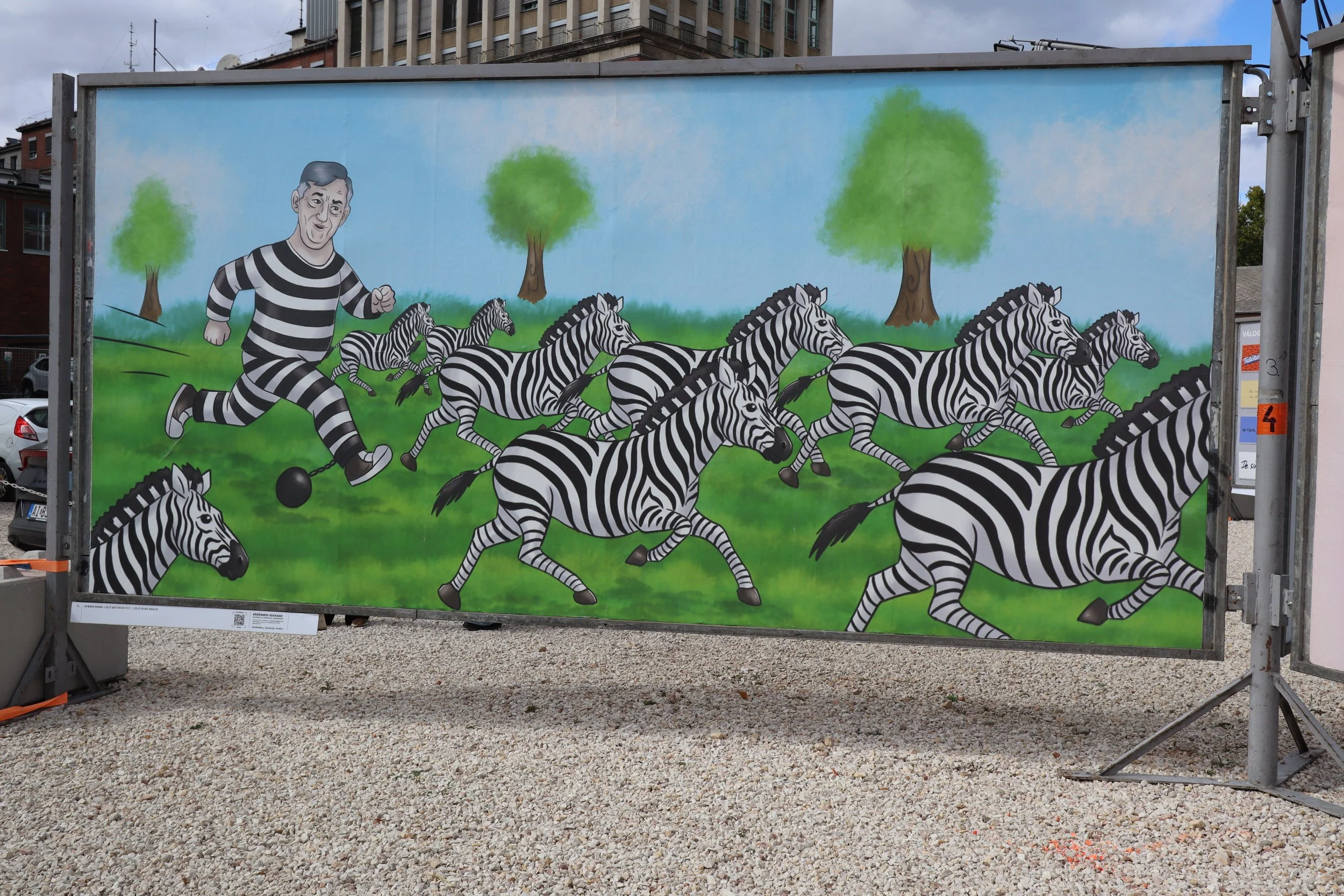
Panni Gyenis- poster entitled: Loló, ‘Runs Brave’ The poster refers to the herds of zebras and antelopes associated with Viktor Orbán’s father at and around the family’s country estate - Hatvanpuszta.
This image reflects the accumulation of personal wealth enjoyed by some individuals ‘close to the fire’ during the Orbán era. The man in the poster resembles Lőrinc Mészáros, a former schoolmate and close friend of Viktor Orbán, who has risen from being a gas fitter to become the wealthiest Hungarian in the country.
His rise to billionaire status, measured in forints, has been closely associated with his various companies winning a wide range of government tenders. Critics would say that this was unfair and that he is, in fact, a ‘straw man’, with some of the rewards from successful tendering being returned to corrupt officials.
Two ministers from the previous Fidesz government have recently been arrested on allegations of corruption. The former Minister of Culture and Innovation faces charges relating to the misuse of cultural funding. The former Minister of National Development faces charges of alleged bribery involving public contracts. And there will probably be more to come.
On paper, Viktor Orbán’s personal wealth is not spectacular, and he lives in a relatively modest property in Budapest. However, his father, Győző Orbán’s, estate at Hatvanpuszta has attracted the attention of opposition media for many years. Herds of expensive zebras and antelopes can be found there, along with other signs of conspicuous consumption.
Győző Orbán owns a stone quarry. His company won the tender to supply stone for the Hungarian section of the new Belgrade–Budapest railway line. Companies linked to Lőrinc Mészáros won contracts or subcontracts to complete this highly lucrative venture. Orbán’s son-in-law, István Tiborcz, owns a company that has carried out work on the project as a subcontractor. He is also one of the richest men in Hungary.
I’m sure the zebras at Hatvanpuszta weren’t involved in any business shenanigans, but others might well be looking over their shoulders.
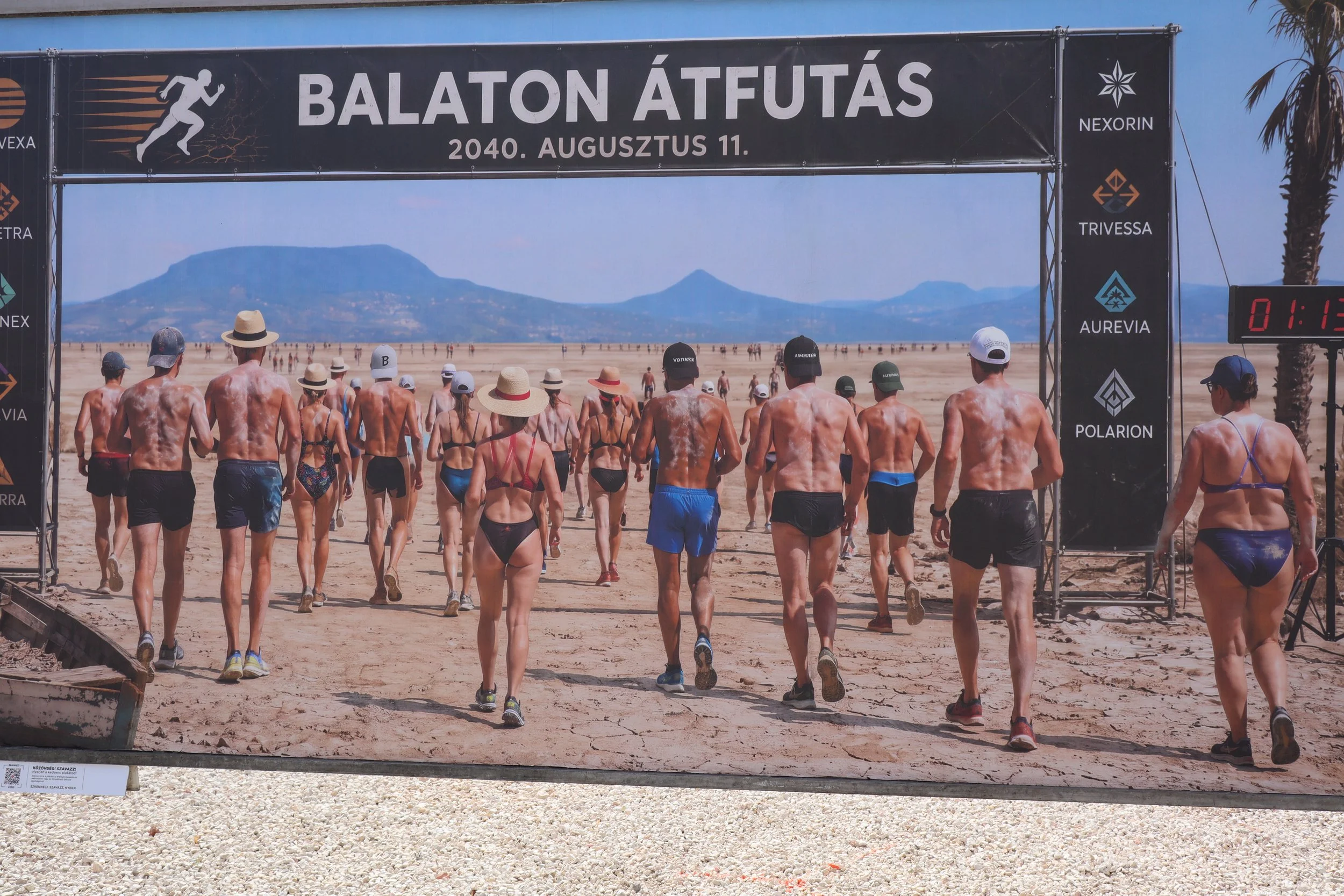
Gábor Veisz poster entitled: Balaton Átfutás — ‘Balaton Cross Running?’. The reference is to the annual swimming event where thousands of people swim across Lake Balaton each summer. Will this be possible by 2040?
Veisz’s poster looks ahead to a future in which Central Europe could become a massive dust bowl. Lake Balaton is one of Europe’s largest freshwater lakes, and the ‘Hungarian Sea’ remains a prime holiday destination for many residents and tourists.
The flatter southern shore is rather shallow, and you have to go out a considerable distance to be able to swim. This summer, the water retreated in a similar fashion along the once-deeper northern shore. Although Lake Balaton is fed by a small but vigorous river in the west, the possibility of ‘the Balaton’ drying up completely by 2040 is no longer in the realms of science fiction. Hungary’s third-largest lake, Velencei-tó, has all but dried up in places, with losses of fish and amphibian life.
Apart from a bitterly cold but dry January, temperatures this year have been above average throughout. A neighbour and regular visitor to Lake Balaton told me that she swam there on 10 October, the latest day in the calendar year that she has ever managed to do so.
It has rained copiously for only one day in over two months in Budapest. Hungary has just undergone another year of drought, and agriculture is suffering badly, as reflected in the prices of fruit and vegetables.
János Lázár, who served as Hungary’s Minister of Construction and Transport in Viktor Orbán’s government, said in 2025 ***:
‘The government made a mistake when it failed to build large reservoirs suitable for retaining water ten years ago.’
He also acknowledged that Hungary had allowed too much freshwater to flow out of the country while failing to develop a consistent strategy for retaining water and addressing agricultural water shortages. Existing reservoirs had largely been built for flood control rather than long-term water retention.
As shown in a recent Reuters special report**, farmers throughout the country are striving to create their own mini-reservoirs to combat the ongoing drought.
I thought the Balaton Cross Running poster captured the challenge ahead excellently.
During the exhibition, the public have been able to vote for the Audience Award winner, who will be announced after the exhibition closes on 18 October.
The best political work at ARC was nuanced and clever. Countries don’t change overnight, and there were warnings to Péter Magyar and the Tisza Party that they mustn’t inadvertently slip into the ways of Viktor Orbán and Fidesz.
And, being Hungary, there was a streak of dark, fatalistic humour throughout. It’s not always something that foreigners can appreciate, but it keeps Hungarians laughing even when they should be crying into their pálinka.
ARC Magazine-https://arcmagazin.hu/main
Arc translates as face. The magazine describes themselves as:
FACE – against absurdity and facelessness!** Reuters special report on drought in Hungary: https://www.reuters.com/investigates/special-report/europe-weather-hungary-drought/
*** Telex news: https://telex.hu/english/2026/08/03/orban-government-failed-to-prepare-country-for-severe-water-shortage-former-minister-admitted-last-year