Janitors Who Made Brush Strokes in History
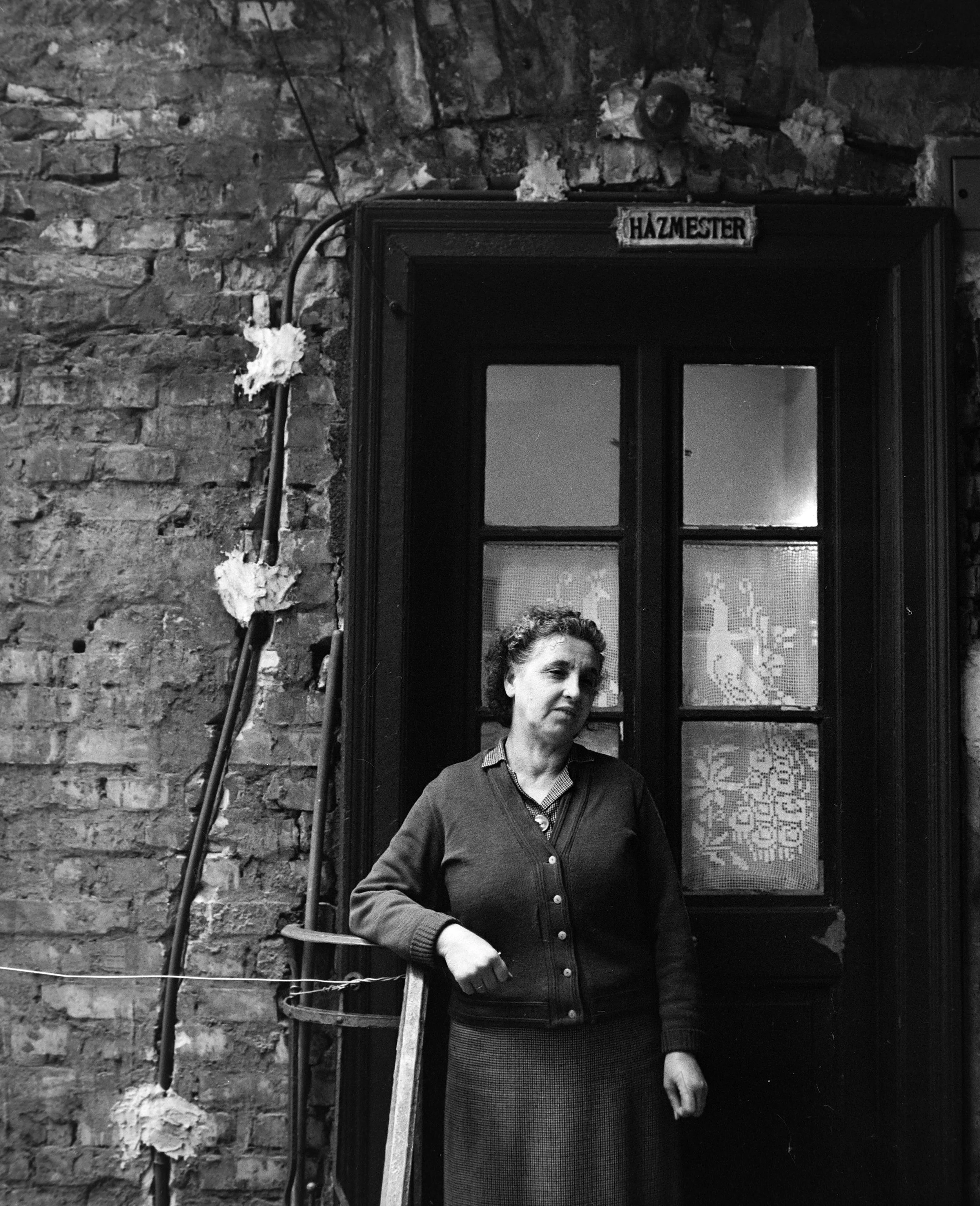
Házmester apartment Budapest-fortepan -Fortepan- Szalay Zoltán-Open commons.
One of the most unpopular occupational groups in twentieth-century Hungary were the házmesterek – building managers, caretakers or concierges as known elsewhere. They provide an intriguing example of how apparently insignificant people can become influential during events of historical consequence. In Hungary, the story of the házmester converges with that of the Holocaust, political extremism and the decades of Communist rule that followed the Second World War.
Házmesterek were not decision-makers in any official sense. Yet they occupied a remarkably powerful position in the life of an apartment building, leaving a heavy footnote in Hungary's twentieth-century history.
As Budapest grew from a provincial Habsburg city into the joint capital of the Austro-Hungarian Empire, a rapidly expanding middle class and migrants from the countryside increasingly lived in newly constructed apartment buildings. By 1900, Budapest was one of Europe's fastest-growing cities. Every new residential building needed someone to look after it.
Initially, many házmesterek worked part-time while pursuing trades or technical occupations elsewhere. The principal attraction of the job was the legally protected provision of free accommodation: a service flat. The drawback was that wages were poor or sometimes non-existent. Building managers relied heavily on regulated payments and tips from residents to supplement their income. Many had moved to Budapest from the countryside and came from poor agricultural backgrounds, including a significant proportion of female házmesterek. The occupation crossed Hungary's religious and ethnic divisions, although its social origins were overwhelmingly among poorer sections of society including rural Jewish communities.
A particularly Central European quirk of Budapest housing involved the front gate arrangements. From the late nineteenth century well into the twentieth, the házmester was generally one of only two people with a key to the entrance: the other was the building owner. By local regulation, apartment front gates were locked at night, traditionally between about 10 pm and 6 am. Residents arriving after closing time had to ring the bell and wait for the házmester to wake up, open the gate and let them in.
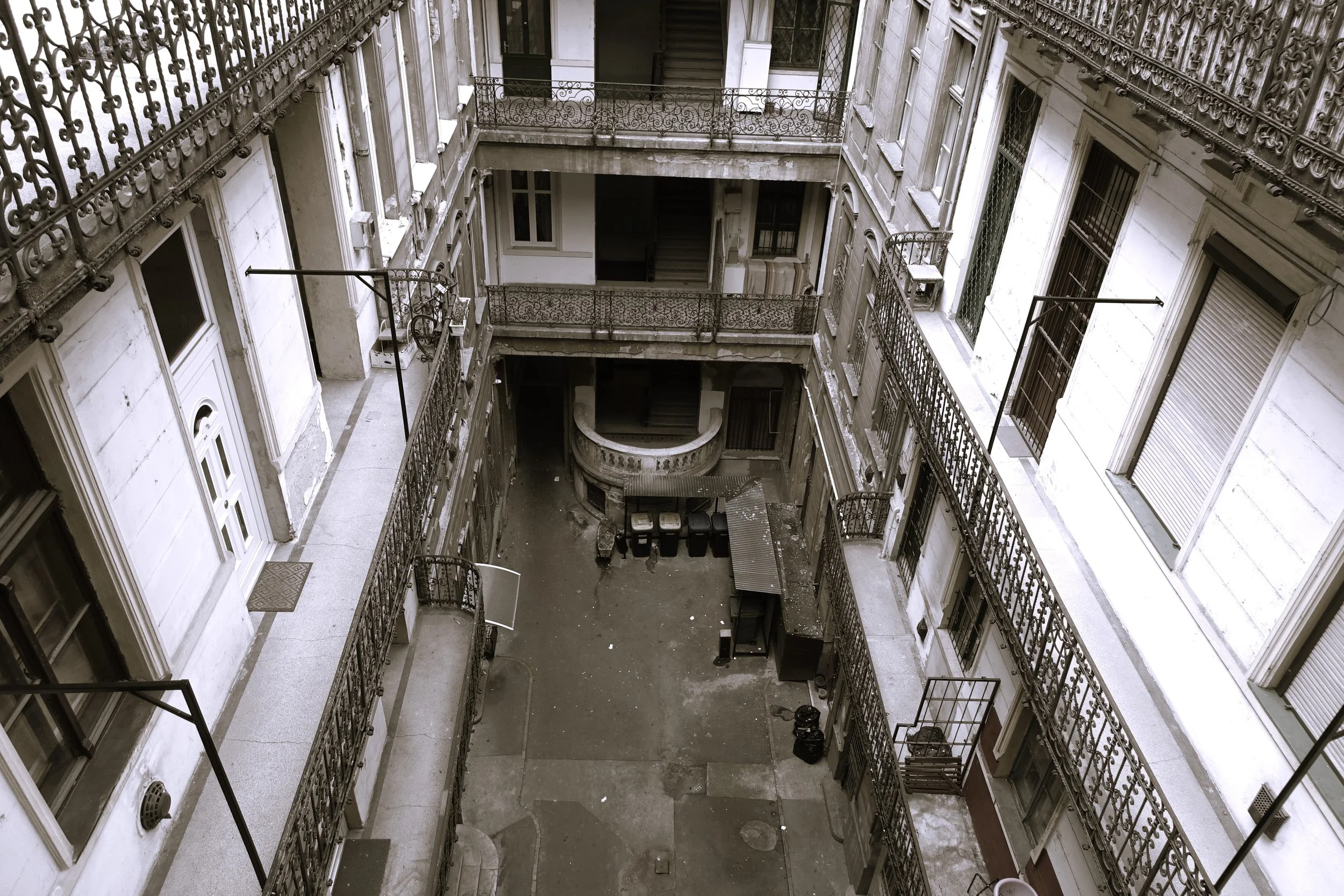
A once grand apartment building (built 1874) in district nine Budapest. The házmester’s lodge was in the bottom left hand corner near the exit gate- indicated here by a plastic cover over the doorway.
The system provided the caretaker with accommodation, but very little income. Regulated payments from residents for opening the gate and operating lifts, when available, became important supplements to his or her earnings. The házmester's lodge was usually beside the entrance and often consisted of a single room. Pal Ádám *, in his detailed and excellent study of Budapest building managers, points out that the restricted living space and economic circumstances meant that házmester families were often small. Mostly they could only afford one child.
From 1896 onwards, Budapest politicians periodically debated whether residents should be given their own keys. The proposal was repeatedly defeated. Building owners were an influential constituency, and giving every tenant a key would have undermined the system by requiring higher wages for the házmester. Supporters of the old arrangement also argued that unrestricted access to the entrance and ground-floor shops would create security problems.*
The key to the building was, in effect, a key to social power.
Kosztolányi ** recognised this power when he made a házmester a significant character in his novel Édes Anna. Ficsor is the building's caretaker during the Hungarian Soviet Republic of 1919 and becomes a committed Communist and political representative within the building. When the Soviet Republic collapses, he rapidly changes political allegiance and ingratiates himself with the Horthy-era elite.
Ficsor embodies the extraordinary informational and social position a Budapest házmester could occupy during political upheaval: he knows who lives where, who visits whom and which way the political wind is blowing.
By the 1930s, Hungary's apartment buildings reflected the country's complex social and religious divisions. Jewish Hungarians formed approximately a quarter of Budapest's population and were prominent among the city's middle and upper-middle classes, while poorer Christians were represented across the rural, working and lower-middle echelons. Not to forget that they also formed the nation’s still powerful, traditional aristocracy.
Antisemitic legislation increasingly restricted Jewish participation in Hungarian society. A 1942 decree prevented Jewish Hungarians from working as building managers, with Christian citizens taking over their jobs and accommodation. During the wartime years there were approximately 25,000 building managers employed in Budapest.***
Pal Ádám* describes the házmester as caught in a class struggle between wealthy building owners and tenants aspiring to middle-class respectability or emerging from the working class. Neither side necessarily liked or trusted the caretaker, who was often regarded as an uncultured outsider from the countryside.
The job was also becoming almost impossibly demanding. By the 1930s, maintaining heating systems and lifts had been added to the traditional duties. And the expansion of Budapest nightlife meant tenants arrived increasingly later than midnight. A husband or wife was essential for the házmester to carry out duties that spanned day and night. In larger buildings a házmester frequently needed an assistant, paid for from his or her own income. Apartment block owners often treated building managers like self-employed entrepreneurs rather than employees.*
János Székely's novel Temptation (1) provides a rare left-wing perspective on interwar Hungary. It follows a poor boy from the provinces who endures a brutal childhood before eventually finding himself living with his parents in the industrial suburb of Újpest. There he encounters the unnamed házmester of their decrepit tenement.
Székely turns him into a grotesque symbol of social inequality. The házmester exploits the tenants' poverty, accepting sexual favours and unpaid labour in lieu of rent. His power grows as unemployment and misery deepen during the Great Depression.
The novel also captures the peculiar mechanics of Budapest apartment life. The family fears the ten o'clock closing of the gate and the payment required to enter afterwards. Later, after a night of drinking and dancing, they wait in desperation for the házmester to let them inside.
When he strikes a tenant without justification, the residents collectively shout “Shame!” It is a rare moment of rebellion in a story otherwise dominated by poverty and powerlessness.
Although the story ends in 1937, before wartime legislation would dramatically increase the responsibilities of building managers, the author looks ahead and tells us that the fictional házmester becomes a concentration-camp commandant during WW2.
After the German invasion of Hungary in March 1944, the apparently mundane business of maintaining a list of residents became potentially lethal. The Nazi authorities required the city’s building managers to establish who lived in their properties specifically in terms of ethnic/religious background. These records became important to creating the system of Yellow Star Houses, introduced in June 1944. Rather than concentrating Jewish people into one geographically defined ghetto, the authorities designated almost 2,000 buildings across the city where Jewish residents were required to live in overcrowded conditions.
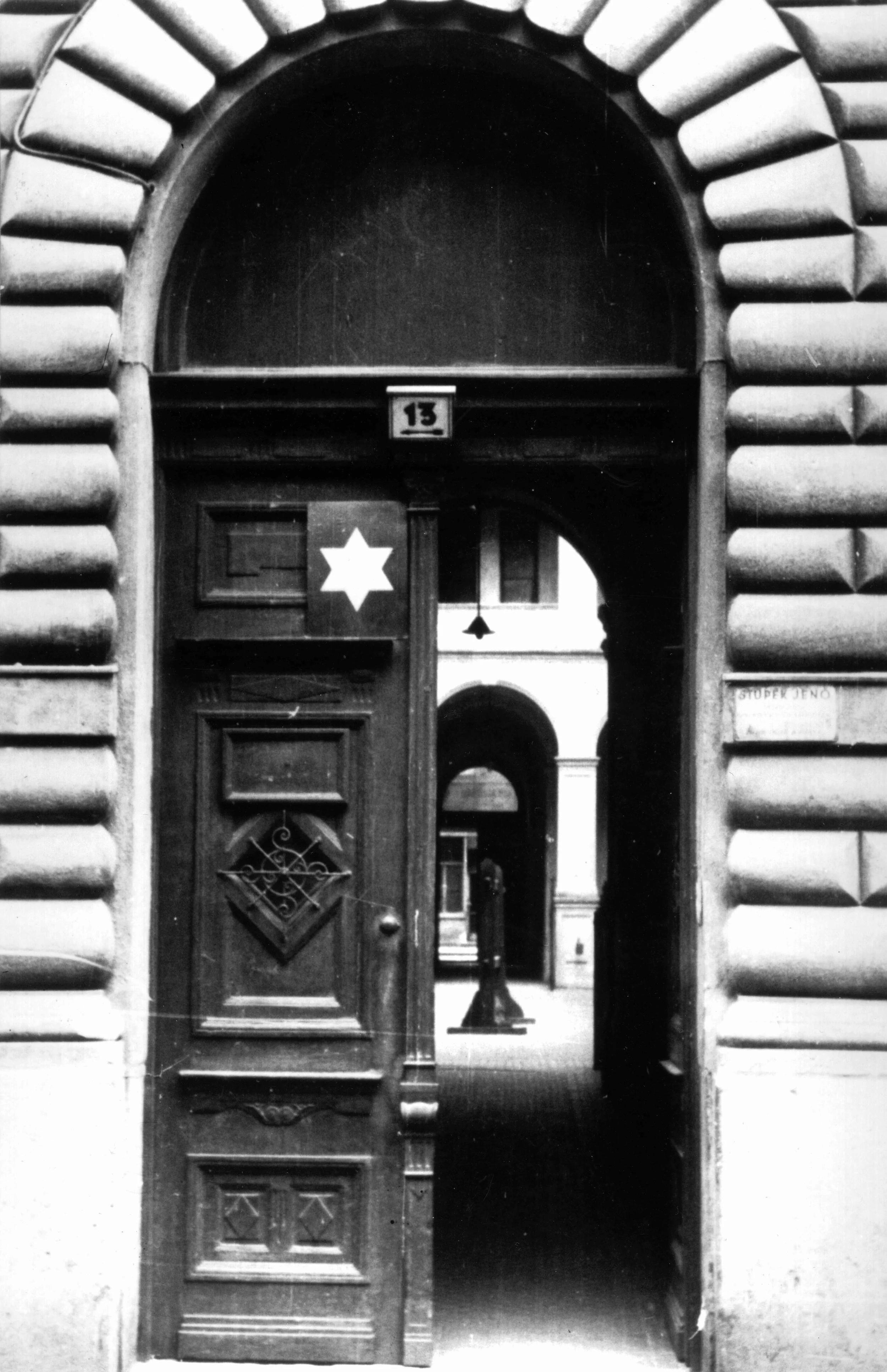
Yellow Star House at Nagy Diófa utca 13. fortepan-fortepan-open commons.
Some 25,000 apartments were subsequently reallocated, frequently benefiting friends and relatives of those with connections to the authorities. As persecution intensified after the Arrow Cross coup in October 1944, Jewish residents were subjected to increasingly severe restrictions. Building managers were decreed to monitor residents, enforce regulations and assist with the distribution of food.
Pal Ádám * argues that from the middle of 1944 házmesterek moved, in different ways and to varying degrees, from being bystanders to becoming perpetrators, collaborators or rescuers.
The response was far from uniform. Some assisted the Arrow Cross; others protected Jewish residents or turned a blind eye to infringements. Seventeen Budapest házmesterek have been recognised by Yad Vashem as Righteous Among the Nations for saving Jewish lives. Pal Ádám* argues that many more helped Jews survive, sometimes at considerable personal risk. Only they couldn’t be recognised as ‘saviours’, because they had received their customary ‘tip’ to provide this assistance. An arrangement understood by all concerned, and one which meant that those Jewish tenants who had become too impoverished to pay, weren’t hidden or otherwise helped by the building managers. Some of the latter also participated in active persecution far beyond their designated role.
The post-war People's Courts faced a difficult task in judging individual házmesterek. The behaviour of this socially marginal group could not simply be divided into heroes and villains.
There was another disturbing pattern. The children of házmesterek were disproportionately represented among the Nazi Arrow Cross party. Pal Ádám* interprets this partly through the social aspirations of a group that had long been despised by both the elite and many tenants. For some young people, extremist politics offered status, belonging and proximity to power.
The lesson is uncomfortable: when a society creates a large, frustrated group with little status but daily contact with people who possess greater wealth and power, extremism can provide an attractive escape from humiliation.
The Communist házmester
The házmester survived the fall of fascism in 1945. As Communism took hold, the old private landlords were increasingly replaced by municipal and state housing organisations, while institutions such as the railway maintained their own housing. In Budapest, the IKV property-management system became the normal employer of házmesterek in state and municipal buildings.
The gates continued to be locked at night and the old system of gate money remained, although increasingly residents could obtain their own keys. Legislation in 1965 made this possible, but traces of the old arrangement continued into the 1970s. (2)
The Communist authorities also understood the value of having eyes and ears inside apartment buildings. In Cseh Tamas’s beautiful song ‘Budapest’ he sings about the grey but predictable Hungarian life of the 1960’s. One memorable line: “Házmesterünknek adjunk szép mosolyokat.” translates as- “let's give our caretaker some nice smiles.” It showed the importance of keeping in the házmesterek’s good books and hints at the role building managers played as part of a wider culture of caution and informal surveillance.
Not every házmester was a secret-police informer. But some házmesterek were recruited, while others could provide information to local authorities or the security services without necessarily understanding where it would lead. The secret police also maintained hundreds of covert apartments in Budapest for agent meetings, sometimes requiring the cooperation or deception of the local házmester (3). The system was less visible than during the Arrow Cross period but potentially more systematic.
Ideology, meanwhile, could prove remarkably flexible. A person who had benefited from one political system could adapt to another. The practical reality was brutally simple: the házmester's service flat came with the job. Lose the job and you lost your home. The key remained more powerful than ideology.
The traditional házmester and the gate-money system gradually disappeared during the 1980s and early 1990s as apartment ownership and housing management were transformed. The old nineteenth-century tenements were among the last places where traces of the system survived. Elsewhere, private sector management companies were contracted to deliver cleaning and repair services.
The házmester was never a minister, general, party leader or police chief. He or she was a person sitting just inside the front door with a key, a register and an intimate knowledge of the building's inhabitants.
Yet that modest position could become remarkably consequential. Perhaps that is why the házmester remains such a powerful historical figure. They were supposed to cleanse the building – sweep its entrance, maintain its heating, operate its lift and open its gate. Yet some of these ‘key players’ left moral stains on Hungarian society that may no longer be visible to the eye, but are still remembered by many older residents.
The twentieth-century class struggles that produced this peculiar occupation are largely forgotten today. Yet Budapest still remembers them in an unexpected place: the wine spritzer.
A házmester is a relatively strong fröccs, containing more wine than a lakó (4)– the resident – but less than a háziúr-the building owner.
Some things, it seems, never change.
Says this self-exiled háziúr with his four deciletres of wine and only one of soda water!
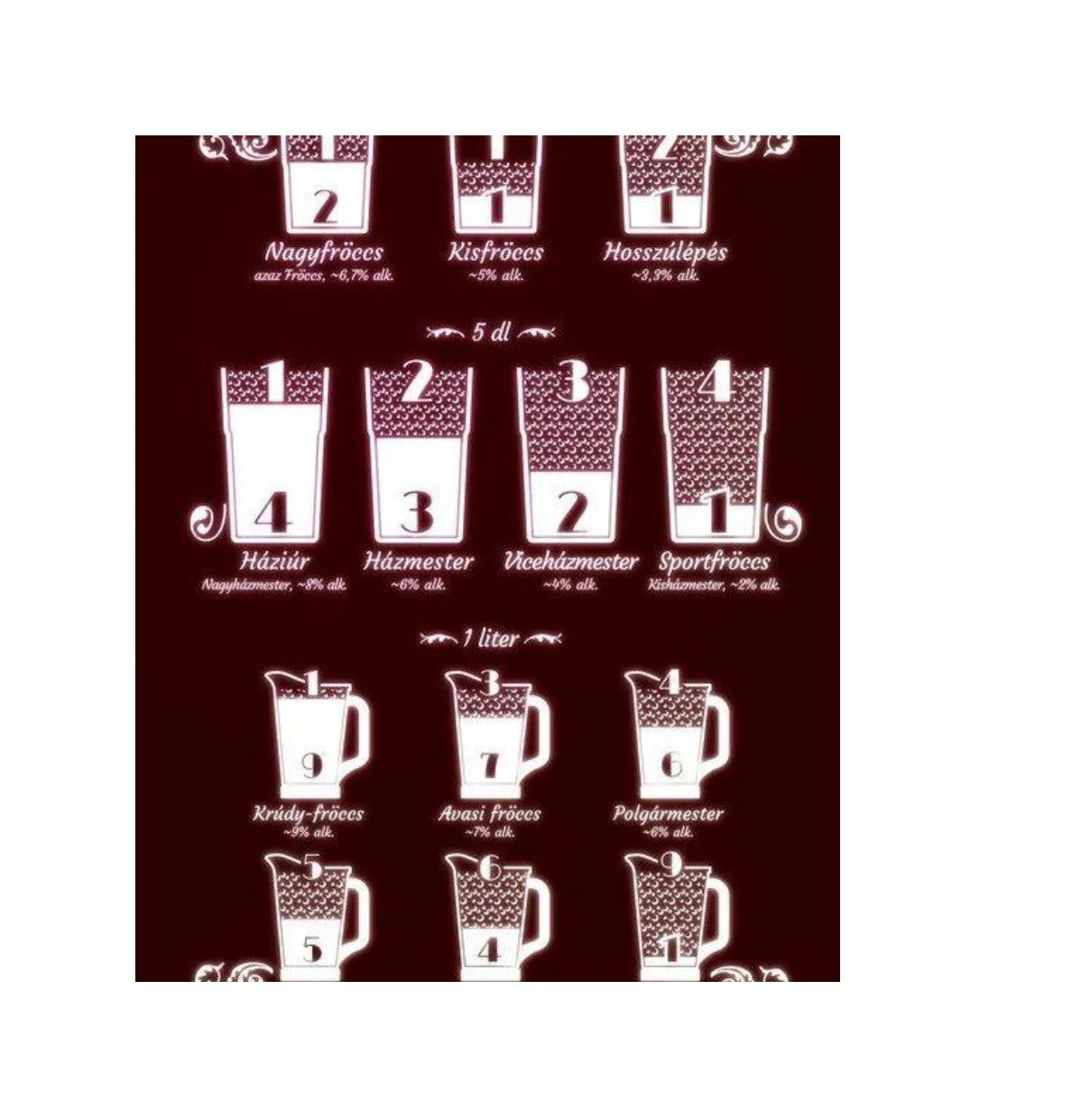
Fröccs proportions- note that the lakó (resident) size is sometimes called a Sport fröccs or kisházmester.
References
* Istvan Pal Ádám- Budapest Building Managers and the Holocaust in Hungary 2016
** Dezső Kosztolányi- Édes Anna 1926
*** A historical-research conference report from the Institute of History at ELTE states explicitly: “Budapesten a háború alatt mintegy 25 ezer házmester működött.” Translates to: During the war, approximately 25,000 caretakers worked in Budapest.
(1) János Székely- Temptation- first published in English in New York in 1946.
(2) See account of Déri Miksa utca 6 on Budapest 100 (houses) website focusing on the 1970’s- https://budapest100.hu/en/
(3) Gabor Tabajdi on Index- article on secret rooms used for secret service meetings-April 2017.
(4) Lakó fröccs- Lakó-fröccs: 1 dl bor, 4 dl szóda also called a Sport fröccs or Albérlő-fröcc