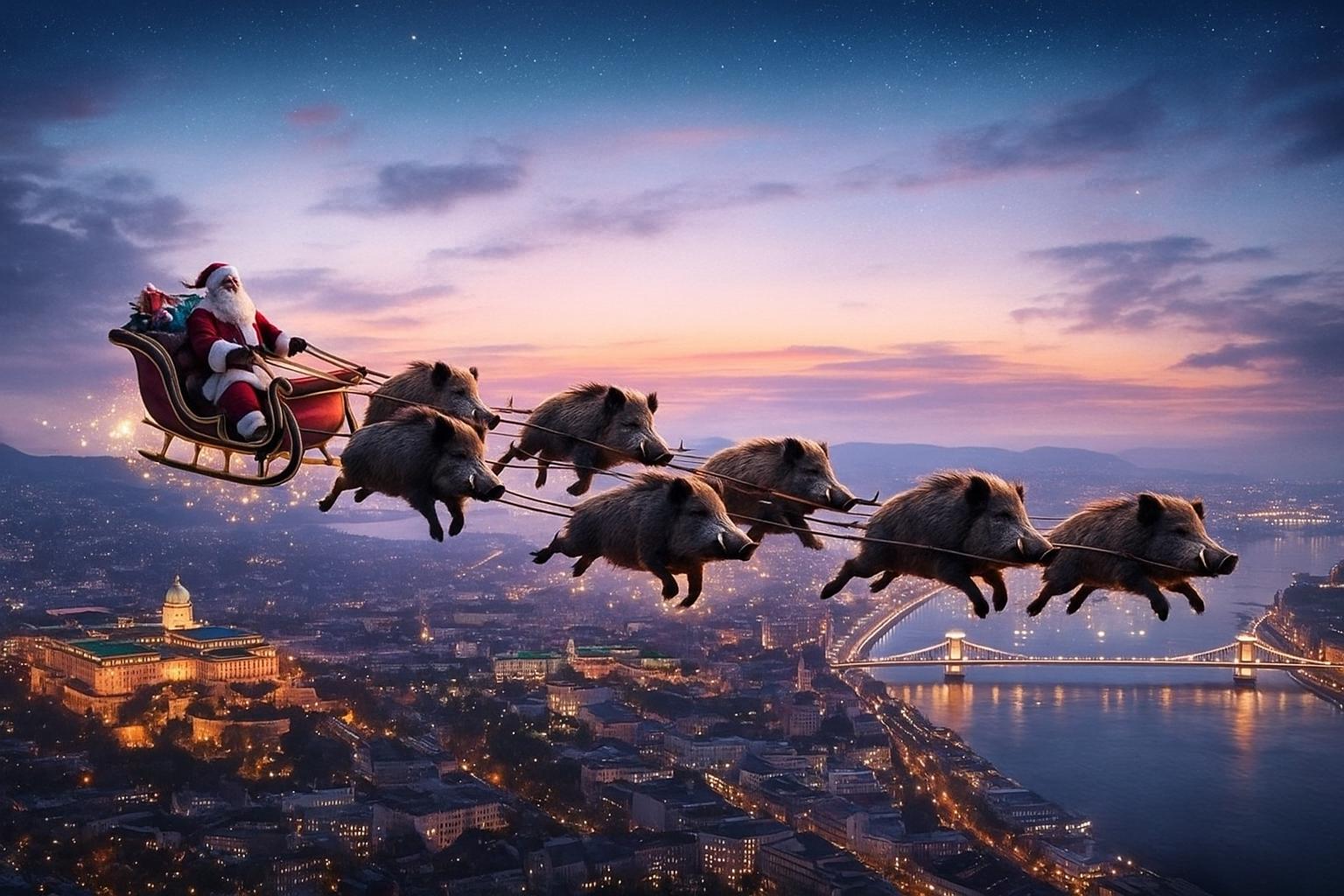
Courtesy of vaddisznok.a.hegyvideken.es.kornyeken-facebook
Often alone and probably lost, wild boar have wandered along the Danube banks into Budapest for decades. Equally, they have always lived in the hilly, forested areas on the fringe of Buda without causing any problems. Now they are making their home within the city limits. An estimated five hundred boar are thought to reside within the Hegyvidék (hill country) district alone. All without entry visas or permanent leave to remain. The very stomping ground of a Lutonian Abroad is being brought into disrepute by these hairy creatures, resident throughout the year.
Such has been their growth in numbers that a dedicated wild boar Facebook page for the district was created during 2025. There are now six thousand five hundred members. People record sightings almost daily, often accompanied by photographs and videos. The supporting evidence includes garden fences knocked down, spring bulbs and well-watered lawns dug up, compost heaps devastated and bags of green waste torn open in pursuit of food. Acorns and fruit fallen from trees are particularly attractive to boar in the autumn, but these omnivores eat almost anything. Herds of up to fifty animals have been recorded, sometimes wandering along main roads, seeking out their next feast.
At night, the boar have been filmed coming down from the Normafa plateau along the green routes into the city below, easily reaching spaces like Városmajor Park with its diverse dining opportunities. Most spectacularly, a boar wandered into the most densely populated part of the district in October and made a daytime visit to DM (like Superdrug) just opposite the local town hall. Unhappy with the options on sale, it made a rapid retreat. There were other lunch opportunities in the vicinity, such as flower beds and bins. Like foxes, urban boar have learnt that there is plenty to eat in a city and humans are not particularly to be feared.
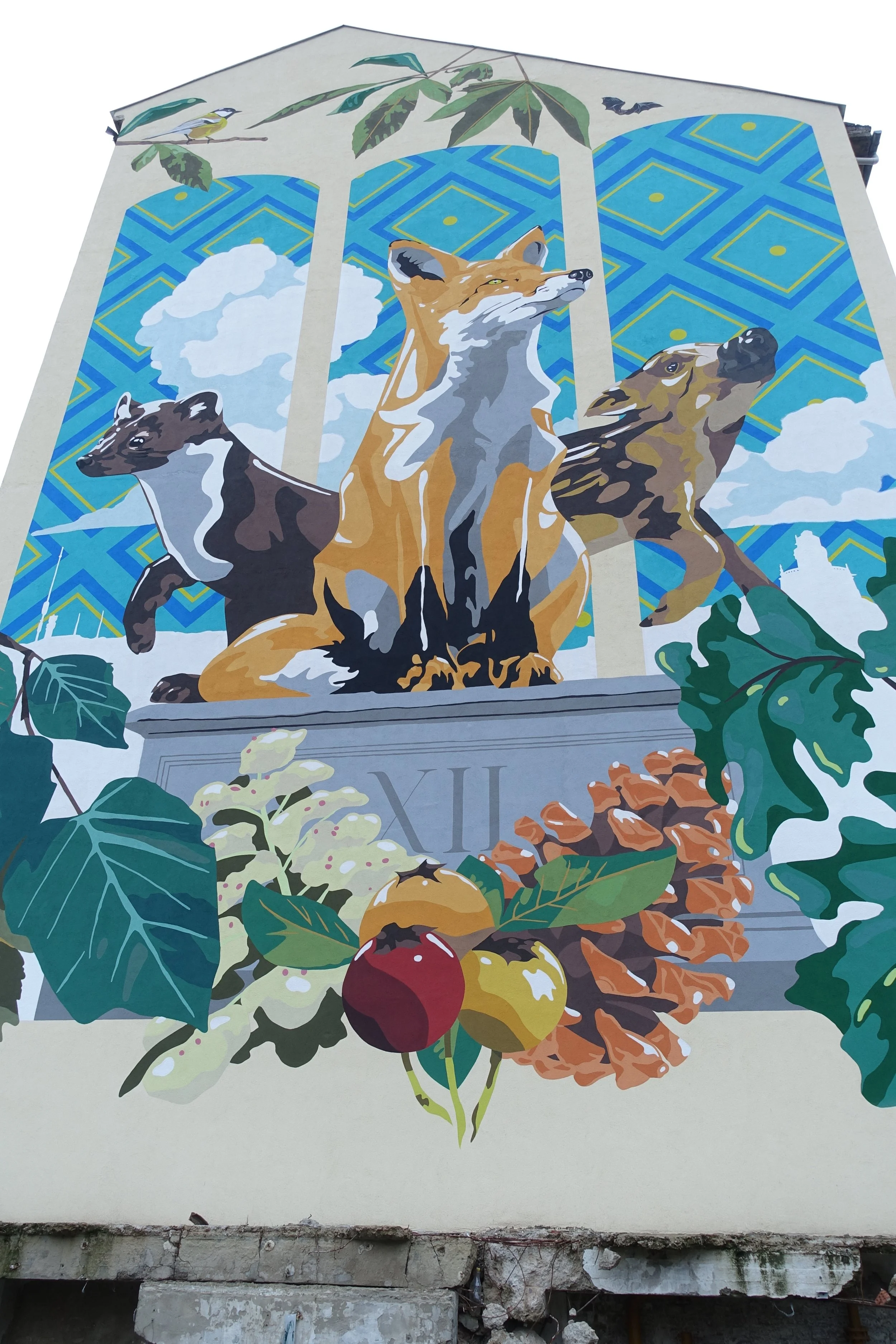
Steet art in Böszörményi út
The absurdist Two-Tailed Dog Party (MKKP) leads the local council but is conflicted in terms of what approach to take. The street art they commissioned in Böszörményi út is an ironic reminder that they were elected in 2024 on a green mandate. Elsewhere in the city, as on Csepel Island, they have protested at the destruction of green spaces. The Mayor of Hegyvidék and national leader of MKKP, Gergely Kovács, has defended the council’s approach. He says that the wild boar herds of northern Hungary are infected with African Swine Fever. While harmless to humans, there are concerns it could spread to domestic pig populations, where its impact is normally deadly. This means that the traditional trapping and release back into the wild approach, previously carried out in Hegyvidék, is no longer possible. Nor can the lethal methods employed by hunters in the game parks be used. The local forest management organisation has no jurisdiction in the capital, and district councils need to apply to the police before enabling qualified professionals to use firearms in animal control.
Instead, the wild boar are currently tempted into traps in district twelve before being euthanised in a ‘civilised’ manner. Not something the MKKP are happy to do, but under current swine fever legislation, they cannot release boar back into the wild. Local residents complain on Facebook that this approach is not being carried out on a sufficient scale to address the problem. At a December district public meeting, the MKKP spokeswoman said that twenty-five boar had been eliminated this autumn. Protestors were quick to ask, 'What about the other 475?' In contrast, the animal rights perspective was expressed strongly by some residents at the meeting. Speakers said that boar posed no threat to human life and should be left alone completely. The animals were here in the hills first.
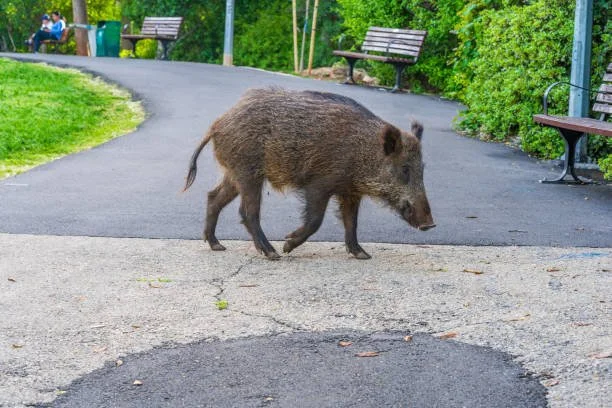
Image courtesy of istockphoto
Boars are secretive, nocturnal creatures which generally avoid human beings. They only become aggressive when protecting their young or if cornered. The famous Hungarian poet and military leader, Miklós Zríny, was gored to death by a wild boar during a hunt in 1664. According to statista.com, wild boar are responsible for about 9 human deaths globally on an annual basis. Half of these taking place during hunting trips. In stark contrast, dogs are responsible for 30,000 human deaths annually (including from rabies transmission). This comparison throws some light on the real danger of wild boar but offers small compensation to those whose gardens have been destroyed or have children afraid to come home from school after dark. Many messages left on the Hegyvidék Facebook page show there is fear in the local community. Some people see certain parts of the district as ‘no-go areas’. The overall tone of the messages leaves the sense that little is being done by the local or central governments to help those impacted.
Why the population has expanded at such a pace recently is another controversial question. The absence of wolves and bears leaves man as the only wild boar predator. These pigs become fertile in their first year of life, and their high reproduction rate is a key factor, but that hardly explains their recent movement into urban areas. One view is that the animals have been driven into the city by excessive levels of human aggression in their traditional forest homes. Certainly, there is a culture of hunting in Hungary with prominent politicians amongst its participants, but would that alone explain such a rapid expansion? Probably not, say the experts. Likewise, humans feeding the boar in city areas will contribute to their numbers but not substantially so.
Miklós Heltai, at the Hungarian University of Agricultural and Life Sciences, suggests that the now resident wild boar population in Budapest has evolved to be genetically different from those found in the countryside. City boars are smaller, for example, but Heltai also points to a difference in one of their chromosomes affecting stress tolerance and sleep, suggesting that the newcomers are more resilient to human proximity. The city boar could almost be seen as evolving into a different species. One capable of residing alongside human beings without feeling an urge to return to the forests.
The loss of the traditional city edgelands is also recorded as a factor. Orchards and small farms once occupied Budapest’s boundaries and served as lines of resistance to boar invasions. Smallholders had a vested interest in pushing the animals away from their land. Now much of that buffer zone has been converted into housing, which can be easily skirted by wild pigs expanding their territory. Growing boar populations are not unique to Budapest. It’s calculated that in Zala County, western Hungary, there are 19,000 more specimens than might be considered sustainable. Professor Heltai says that these issues are facing the whole of Europe, wherever the animal is found.
It’s worth remembering that the Prime Minister, Viktor Orban, is also a resident of District 12. His views on what should be done about the growth of this particular migrant community remain unknown. A fence such as the one he had built against illegal human entrants on the Croatian and Serbian borders would be too late to deal with the situation in Viktor’s locality. It’s not so much that the horse has bolted. Rather, that the boar are already straggling in the undergrowth around his villa and unwilling to depart of their own accord.
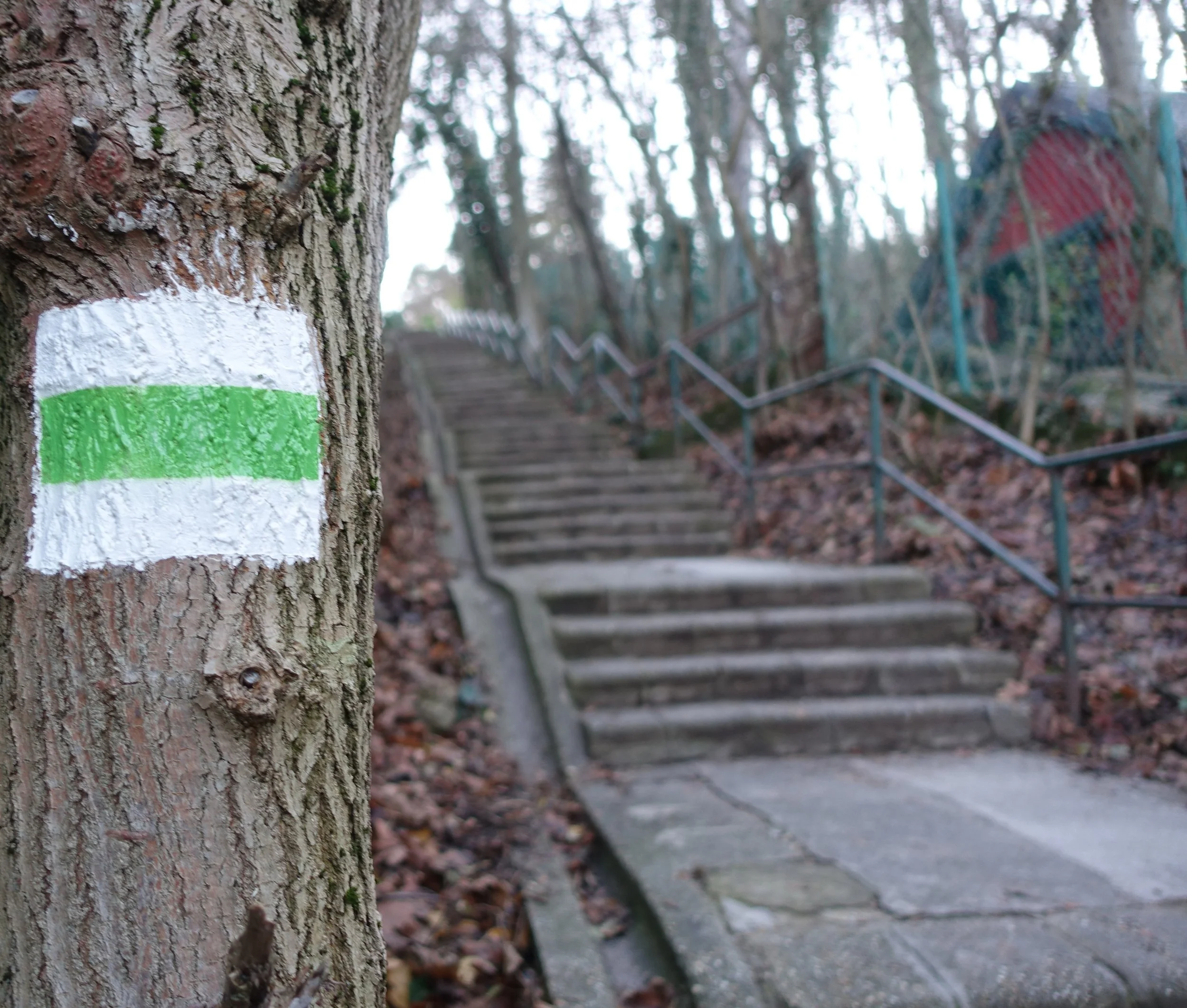
Long distance ‘green route’ leading down into Buda.
My attempts to take photographs and illustrate the situation locally have failed. Despite the video evidence of their nearby presence, I have yet to encounter a city boar, let alone be in a position to photograph one safely. Although daytime sightings are on the increase, they generally appear after dusk. A camera flash at night could lead to panic among these normally passive creatures, resulting in dangerous consequences. They almost certainly follow the green walking route down to the city. And also, that of the cogwheel railway, through steep valleys into the heart of Buda. Soon, some brave boar may pluck up the courage to sneak on board a train at the last moment without buying a ticket. From the terminus it’s a short shuffle to the Mammut shopping centre for last-minute Christmas bargains. So named after mammoth remains were discovered during excavation work. Unlike those long-gone woolly creatures and despite African Swine Fever, it seems that wild boar are here to stay. One projection is that their numbers in the Hegyvidék district could rise from five to eight hundred next year. Unless new methods of encouraging them to leave the city are found, the ‘Budapesti’ must find a way to live alongside these intelligent, if sometimes antisocial, creatures.
Merry Christmas! Happy New Year!
A Lutonian Abroad and the City Boar of Budapest.
Courtesy of vaddisznok.a.hegyvideken.es.kornyeken (facebook page)
Sources
https://telex.hu/techtud/2025/11/09/vaddisznok-xii-kerulet-egyutteles-sertespestis-veszely
https://www.facebook.com/groups/vaddisznok.a.hegyvideken.es.kornyeken