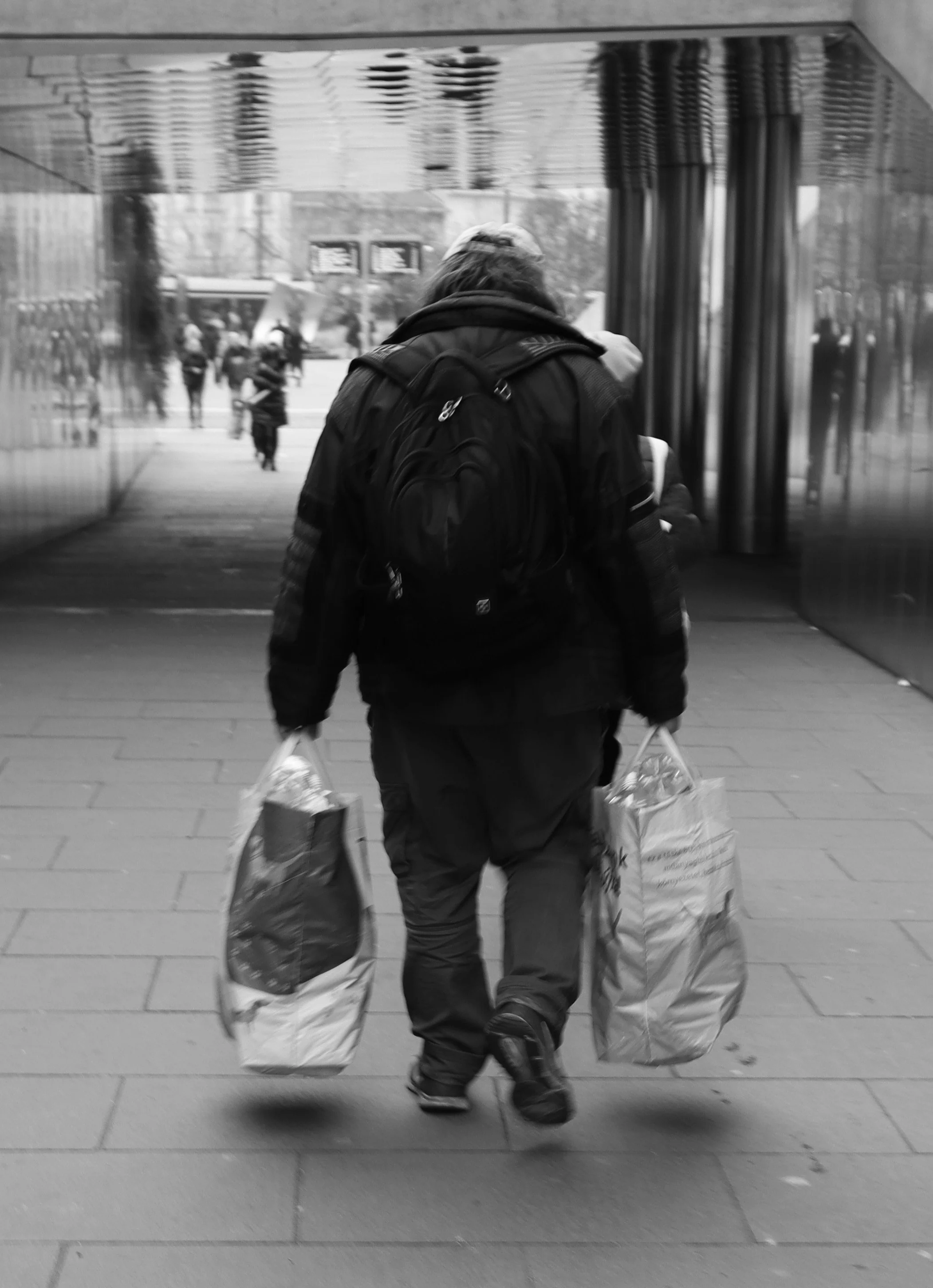
One of Budapest’s many urban foragers
There used to be a satisfying crunch as wine bottles hit those already lining the local recycling bins. Now there’s a disappointing thud and roll because the bins are almost empty. Most people are taking advantage of the government’s recycling scheme with its payback system. This was introduced in January 2024 as a response to an EU directive aiming to strengthen recycling across the continent. It covers some metal cans as well as specific plastic and glass products. MOHU is the government-created company that manages the process and the REpont recycling technology.
The incentive to recycle is because consumers have already paid an extra 50 forint (11 UK pence) on designated original purchases. This represents a significant additional cost to the price of cheaper products, say, plastic mineral water bottles, and a surcharge on more expensive ones like wine or beer. The REpont recycling points are often in or near supermarkets, as the larger outlets are obliged by law to offer this service. Items can be returned at any of the recycling points, and small retailers can also join the scheme. The 50 ft return per item is made in the form of vouchers or paid directly into consumers’ bank accounts. Returns can also be directed to a short list of charities. And some products of unusual design attract higher return rates. Like fancy beer bottles.
While the REpont points are busy with general shoppers returning recyclable goods they initially purchased, there is also a steady stream of people returning products purchased by others and left out as waste. If you observe any busy public place in Budapest for just a few minutes, you will see people scouring the bins in pursuit of bottles and cans. Most foreign visitors to Hungary are unaware of the recycling scheme and will rarely track down a REpont outlet. There were six million foreign visitors to Budapest in 2024, with an 18% increase on that figure by May 2025. Visitors swell the number of recyclable products purchased. Many of which will end up in domestic waste or in streetside bins and become rich pickings for the city’s needy.
People going through the bins in Hungary was already typical before the recycling scheme began. Far more noticeably so than in the UK. Residents even leave good-quality items like clothes near the top of domestic waste, wrapped up, so that they can be easily found. But the current scale of scouring and its wider outcomes were hardly expected.
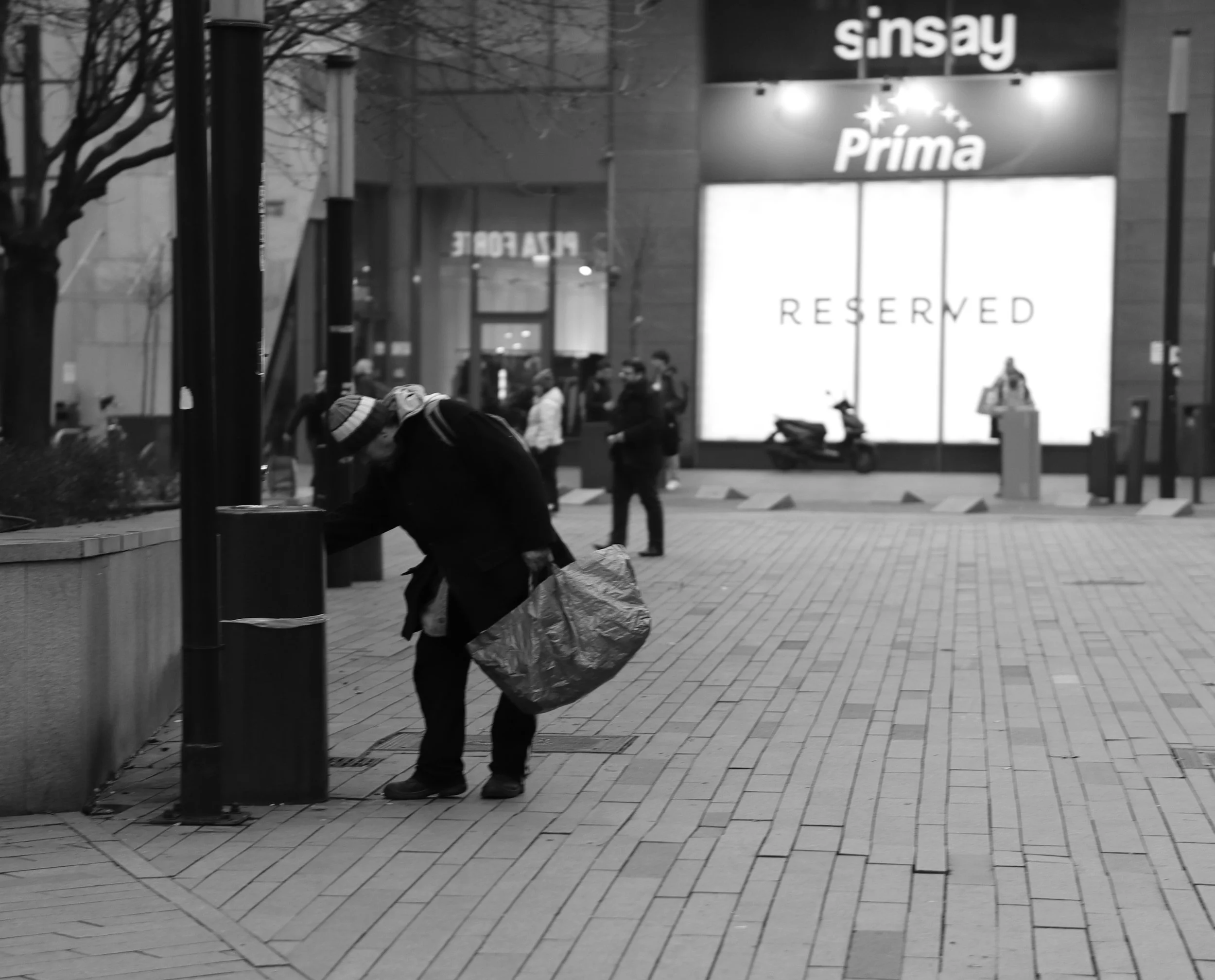
Bin search at Corvin Sétány
For example, the number of beggars seems to have fallen considerably since 2024. I don’t have any hard evidence to support this view other than personal experience. Apart from Big Issue-type newspaper sellers, I can’t remember being asked for money anywhere recently. The opportunity to search a busy area for recyclable matter and cash in on it quickly seems an easier option than standing with your hand out and being largely ignored. In terms of the general ambience, this outcome feels like a real positive. More vigorous policing may have contributed as well, but I’m not aware of new measures. The number of desperate-looking poor people hasn’t decreased though. Only now, they have a different means of alleviating their situation.
Secondly, a new, unofficial occupation of urban forager has emerged. Mostly middle-aged or older and frequently men, the most committed foragers travel the length and breadth of the capital to fill their huge rucksacks and large-sized shopping trolleys with recyclable matter. They spend hours in pursuit of their target products, familiarising themselves with domestic recycling schedules and targeting tourist hot spots where much plastic is deposited, particularly during the thirst-creating summer months. Travelling on public transport, the professional forager easily takes up the space of at least two regular passengers. There’s a lot of creaking and clinking if you’re standing alongside. These are dedicated collectors who are out early and work all day, sometimes into the night with torches and headlights. You need a good work ethic to bring in the returns I often witness. Other foragers operate on a more casual basis depending on their needs.
During communism everyone in the labour market had a job. It was a crime to be unemployed. A popular adage in the Soviet Union from those times before 1989 was, ‘We pretend to work, and they pretend to pay us.’ Despite some improvement, wages in Hungary continue to be low. After three years of inflation, Hungarian purchasing power is below the average in the European Union. Countries with economies which ended communism in a worse state than Hungary’s have now surged ahead. It’s not surprising that many people are seeking income support from the bins.
Many of the organised foragers are not shabby, just poor. Unemployment benefit is paid at 60 per cent of one’s previous salary for 90 days only. If still without employment after that period, a kind of workfare system operates where you receive minimal financial support but only by working full-time on a public works programme. State benefits directed to supporting families are generous by European standards though and organised through the tax system. For example, a woman who has given birth to or raised four or more children is exempt from personal income tax for the remainder of her life. An overgenerous concession to the better-off, some would argue. Means testing is not as refined in Hungary as in Western Europe and benefits are disproportionately more generous to families than single claimants.
Developing a strong middle class based on family and employment was one of the goals of the Fidesz party. A class that would be accessible to a wider group than the ‘nomenklatura’, which had access to most of the country’s wealth at the end of communism. In Budapest and the wealthier western part of the nation, there are sufficient signs of conspicuous consumption to suggest that this process has occurred. Whether a new nomenklatura, based on party/family connections and nepotism, has developed in place of the leftist one is a controversial subject. It will be hotly debated this spring as a general election approaches.
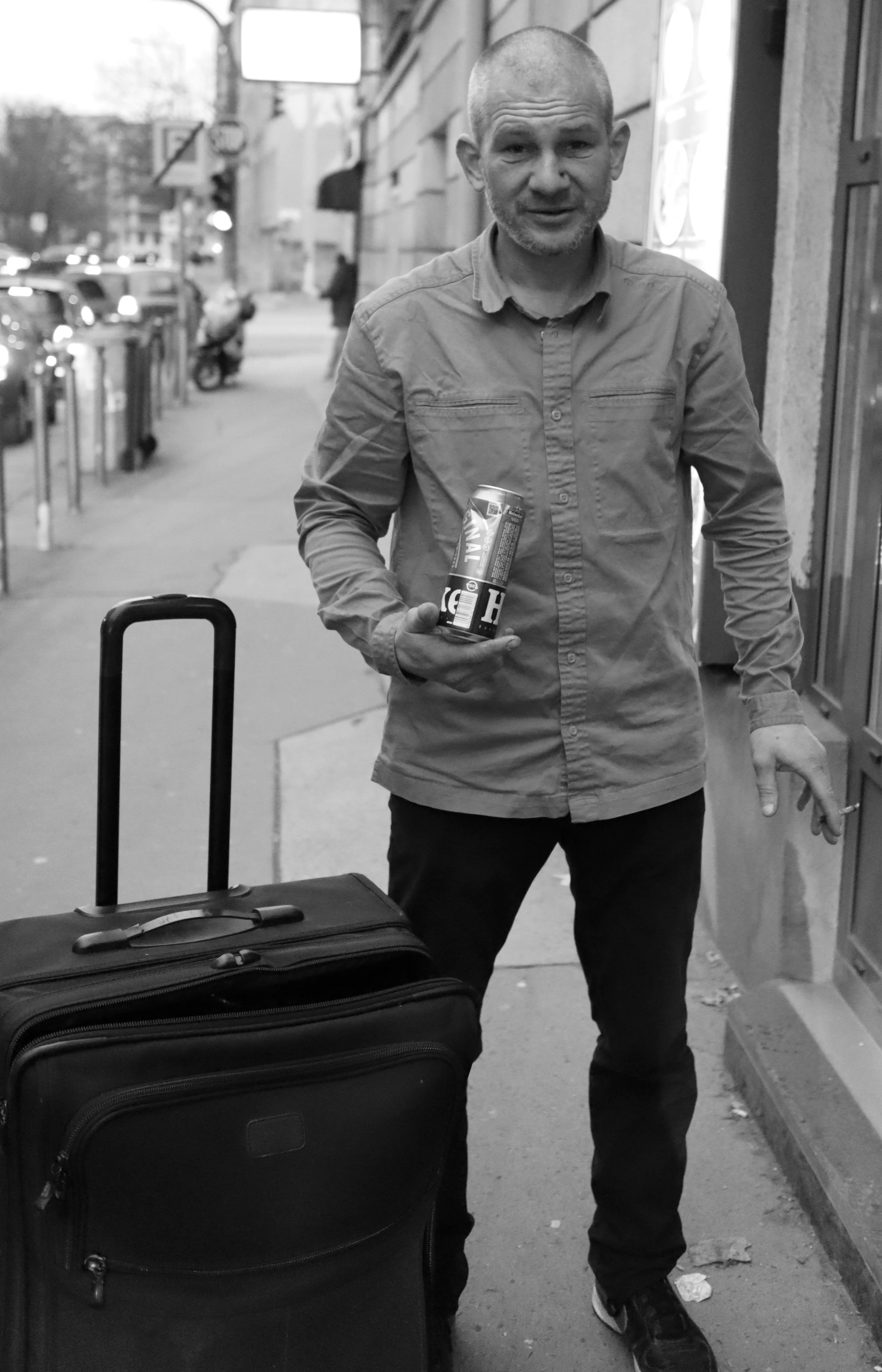
Ferenc-an enterprising forager.
Just off Alkotás utca, I met Ferenc. He was clean and tidy but told me he was homeless. He said he learnt English in 2005, and he spoke reasonably well. Despite the chilly winter air, he worked without a coat and moved around the streets at an impressive pace. Too quick to catch cold, he trailed a suitcase behind him to store his returns and showed me a metal can he collected, as though proud of his profession. Then he recommended a nearby Chinese restaurant for cheap and tasty food. His ‘work’ was keeping him above the hunger line.
Some collectors operate on a less organised basis. The people queuing at the REpont facility at Déli pályaudvar station are often alcoholics or drug addicts. Some look dirty and derelict. One man complained that he should have received more than the 950 forints voucher he waved around unhappily. His earnings would buy him a cheap bottle of wine or a slice or two of pizza. Complaints about the REpont technology are not uncommon.
Some of the collectors also seek out clothes and food. At Batthyány tér, directly across the Danube from the Parliament building, a woman topped up her flask from unfinished cups of coffee. Then tapped the tobacco from half-smoked cigarette butts into a container. While I observe her near a zebra crossing, an approaching vehicle utters a short sharp bark, telling me not to cross the road. It was a ‘civilian’ vehicle, and behind it were a police car and two limousines with darkened rear windows, with more police cars in the rear of the procession. Forced to slow by the almost stationary traffic beyond the crossing, a passenger in the back seat of one limousine moved forward to speak to the driver. I wouldn’t swear to it in a court of law, but I am almost certain that this was none other than the Prime Minister, Viktor Orbán. Probably returning to Buda after his regular Friday morning broadcast on Petőfi Radio. There were rich pickings in the many bins around the square, but his cavalcade didn’t stop to scour the neighbourhood and carried on towards Margaret Bridge.
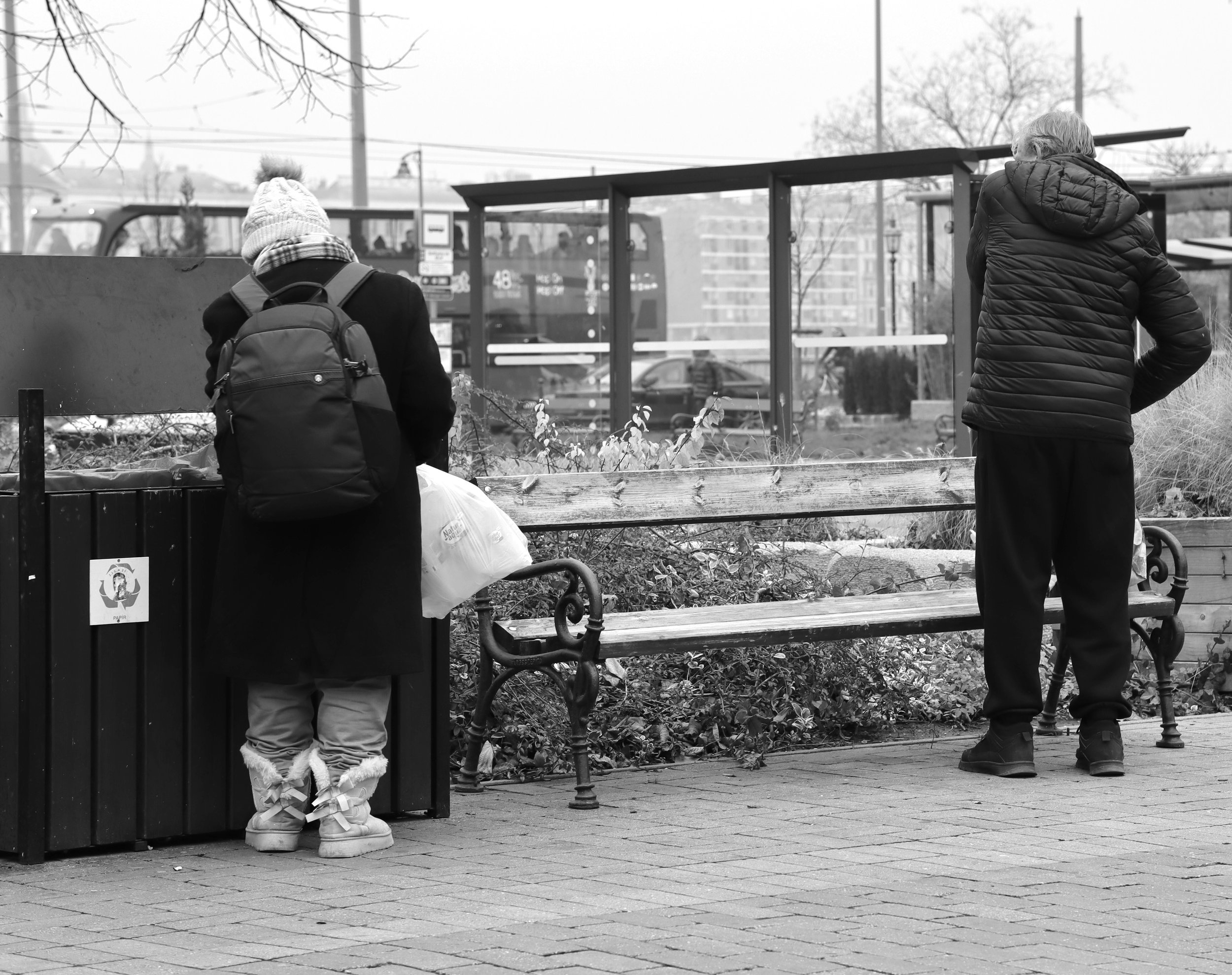
Foragers take it in turn to search at Batthyány tér.
Advertisements at bus shelters tell us that not only will the thirteenth-month pension payment be reinstated but also a new fourteenth-month cheque will be introduced. Pensions in Hungary were shockingly low in relation to costs, with most seniors only receiving a low entitlement. They have gradually improved, but only a minority have paid into private pension schemes, and the ‘occupational pensions’ supported by employers in the UK are not in place here. As a result, there are many poor pensioners, and some form part of the foraging community. More income support in action.
MOHU announced on their website that three billion items had been recycled by September 2025; that’s 15 million per day. For most residents, there is a simple financial incentive to recycle goods and maintain a circular economy. MOHU state that people have requested 120 billion forints in redeemable vouchers from the REpont system so far, leading to additional revenue for the retail partners. Hungary is proceeding to meet its recycling targets.
Most Hungarians I speak to, of varying political colours, think that the unexpected outcomes from the EU directive are also beneficial. Begging is often frowned upon but people are rarely contemptuous towards those trawling through the bins to support their existence. Some even see it as enterprising behaviour, transferring wealth from those who can’t be bothered to make returns towards needy others instead. Only one person I know who has come back to Budapest after living many years in North America described it as a situation where ‘people have to live from the trash cans.’
Hungary has come a long way since the fall of communism but is either too poor or too reluctant to provide the scale of welfare provision found in Western Europe. Notwithstanding the current economic woes facing Britain, France and Germany, their ‘social nets’ are supported by reserves developed from centuries of wealth generation. Hungary is in the early stages of this process. As the international rating agencies declare Budapest at junk-level creditworthiness, in light of its ongoing battle with the central government over funding, it is clear that Hungary has become a middle-income country with advanced economy costs. The forthcoming election is projected as a battle between conservative and liberal values. The result may come down to individual financial concerns – as James Carville advised Bill Clinton – ‘It’s the economy, stupid.’
While the successful national recycling scheme will hardly impact the general election result, its visual consequences still illustrate the current state of play in terms of wealth and how it is distributed within the country.
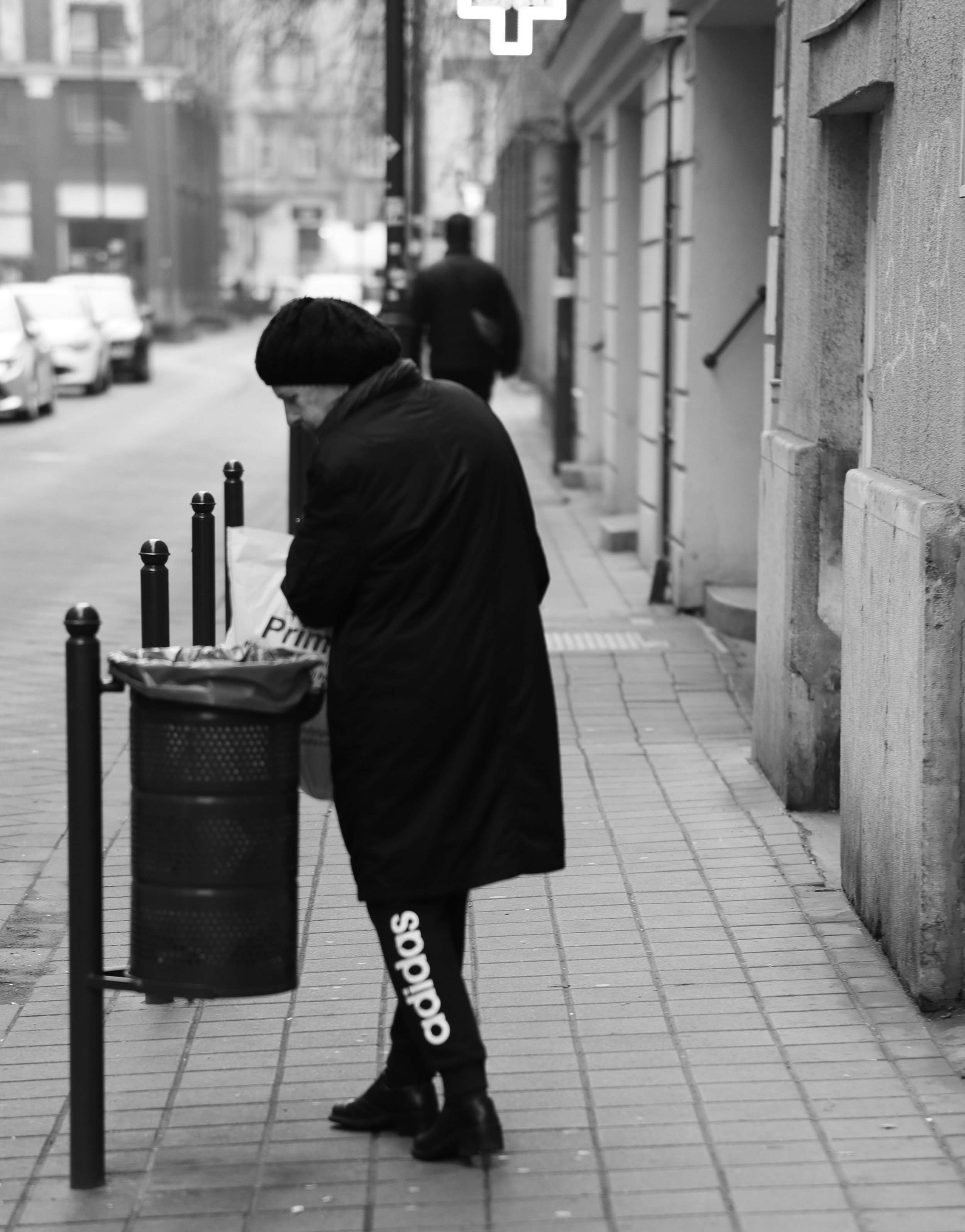
Bin search in Ferencváros.
Sources: https://mohu.hu/hu
https://www.visualcapitalist.com/ranked-european-countries-by-income-adjusted-for-living-costs/
https://www.euronews.com/business/2025/12/30/budapests-credit-rating-falls-to-junk-as-funding-row-with-orban-government-deepens
https://bbj.hu/budapest/travel/tourism/tourism-agency-2024-record-year-for-hungarian-tourism/