The Street of Many Names: A Saunter Along Budapest's Grand Boulevard
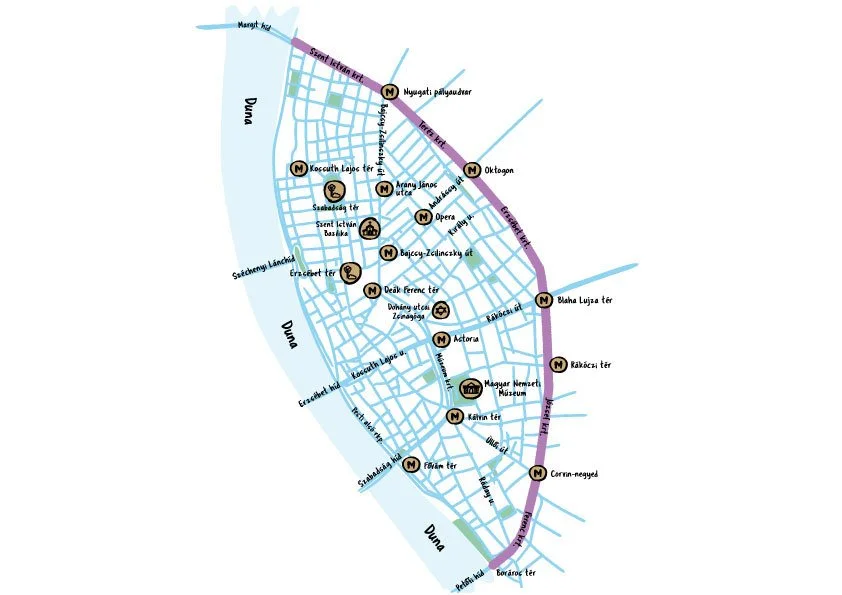
Pest side of the Grand Boulevard. The route continues over Margaret Bridge at the northern end for a few further kilometres into Buda along Margit körút.
I chose to start my walk at the southern point of Nagykörút, at the boulevard's poorer end. The first section – Ferenc körút rises stylishly beyond Petőfi Bridge. The nineteenth-century buildings are four to six floors high, built in impressive historicist style. 'Historicist' means eclectic, drawing from and mixing earlier styles of architecture. The ground-level shops also exhibit a diverse range. Some of the nearby gentrification from District Nine has drifted onto the boulevard in the form of health food and outdoor pursuits shops, but this is a dreary stretch of road. Pawnbrokers and second-hand clothes shops reflect the old Ferencváros and the current economic malaise of the country. The three-star Hotel Swing has been closed since before the pandemic: it’s lost its mojo. Former Hungarian restaurants and cafes have been replaced with pho and other Asian cuisine, offering cheaper options than a decade ago.
Students and young professionals are over-represented. From wandering Ferenc körút, it would be easy to think Hungary is a youthful nation. In fact, the population is greying as quickly as in many parts of Europe. District Nine happens to be just across the Danube from three major universities and close to many places of employment. Mortgages and rents remain tolerable to young people in the districts edging the Grand Boulevard. Think of places like Islington or Camden in comparison before they became super-expensive London boroughs.
Accommodation sits above and behind the shops, and the curving boulevard remains densely populated throughout. Commercial premises line every metre of frontage from one end to the other, and there’s not much you can’t buy somewhere on the Nagykörút. Seen from the numbers 4 & 6 trams, running its length twenty-four hours a day, the shops become an endless blur: instantly forgettable to me. It’s hard to imagine that much of the Pest section was built from 1871 on top of an old marshy branch of the Danube that was gradually drying up. The building work was completed by 1900, and the Nagykörút is considered by experts to be the best-preserved nineteenth-century boulevard remaining in Europe. Not that this leaps out at you in Ferenc körút. At ground level, you could be walking down any faded high street.
Like the entire Pest section, the körút is 45 metres wide and tree-lined. I looked up, trying to find inspiration in the upper floors. Apparently, the eclectic approach in architecture reflected the aspiration of a newly confident nation, merging different approaches even in the same building. A simple message that the past would be incorporated but not slavishly followed.* In 1900, among world cities, only New York was growing at a similar pace to Budapest. In 2026, progress is somewhat absent in tired Ferenc Körút.
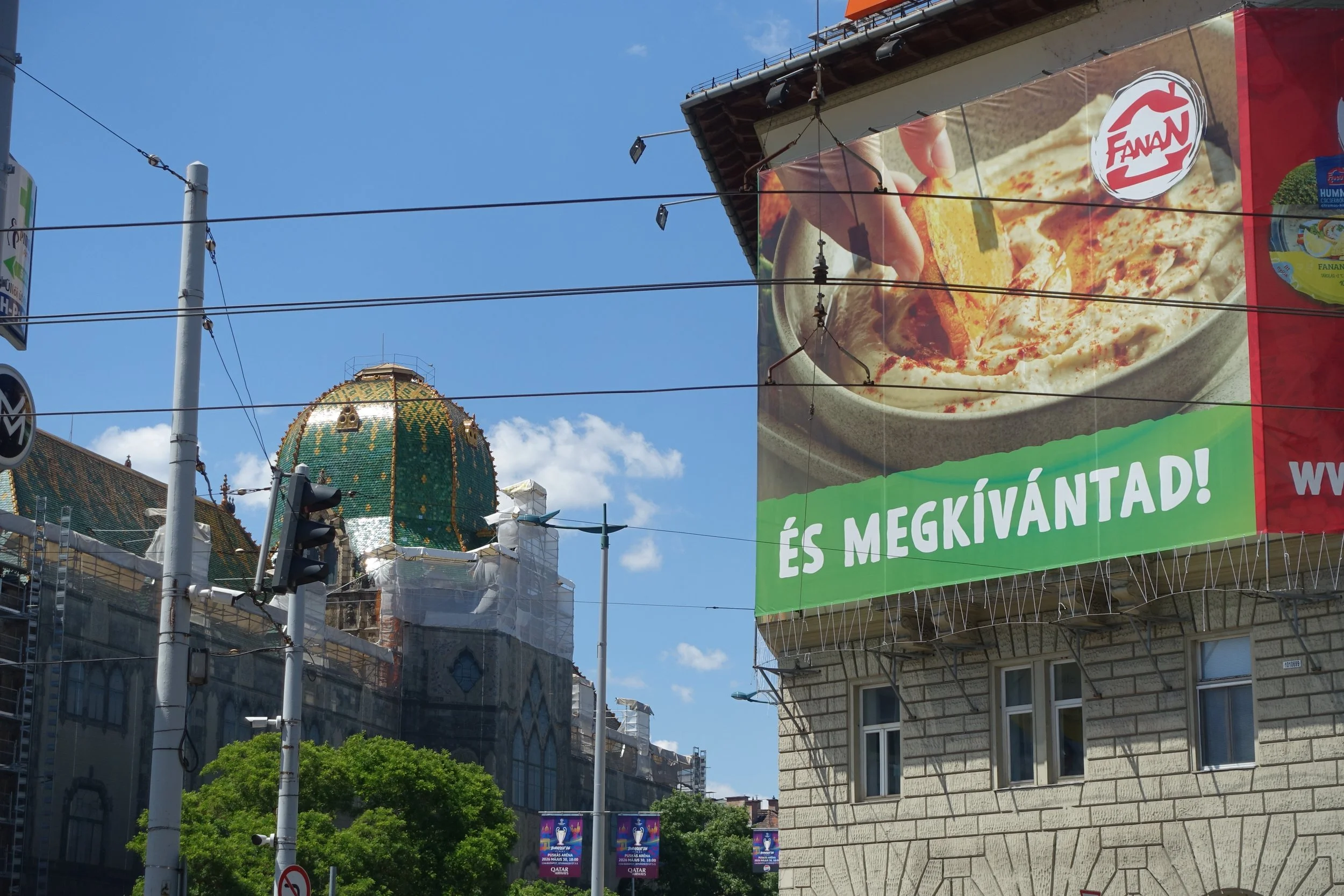
Museum of Applied Arts and advert suggesting what one should suddenly crave to eat.
Things pick up when I reach the noisy road junction of the Corvin Quarter. The beautiful Applied Arts museum, just off the boulevard, always grabs my attention. With its amazing mixture of Secessionist**, folk art and Indian motifs, this is one of the capital's most brilliant buildings. Why it has been closed since 2017 remains a mystery, and recent reports suggest that the building is decaying and falling apart. What should be an outstanding visitor attraction is maybe an example of the money running out. Or failing to reach the right destination? Or never allocated in the first place?
The next section of the boulevard, József körút, begins here at the Corvin crossroads: a place of iconic working-class resistance during the uprising of 1956. Russian tanks were held up for seven days by local youths, and scarred buildings still stand in the surrounding streets. The grand boulevard exists as a major dividing line. The area to the west is the Palace district, where nineteenth-century magnates built their city retreats. Stylish buildings like Budapest University of Jewish Studies, the National Museum and the Central Library are all nearby. In fact, many major attractions lie to the west of the Nagykörút throughout its length, often forming a porous frontier between the land of tourists and the world of the locals.
In Józsefváros, streets mainly to the east of the Nagykörút were subject to communist experiments after the Second World War. Large bourgeois apartments were subdivided to accommodate Roma families, moved in from the provinces to improve their social mobility. District Eight has become the most cosmopolitan and socially varied part of Budapest. Yet it remains distinctly Hungarian and old-fashioned, street corners seeping with long-forgotten stories from the past. Waiting for modernisation that progresses at a stuttering pace.
Eastern Józsefváros is the poorest part of the inner city with patches of gentrification along its edges. I ate a sandwich in a small modern art gallery run by friendly Turkish people. The woman serving me said she was an experienced Biology teacher from Istanbul. She would like to teach here as well but her Hungarian isn’t good enough yet. Her chances could one day be promising as the local secondary schools are crying out for science teachers.
Foreign exchange bureaus are dotted along the boulevard. Customer service may be somewhat absent from the employees, but you can still achieve the best forint rates in the capital. Particularly in Józsefváros. During the last decades of communism, the Nagykörút was known for cafes, bars and hotels where ‘hard currency’ could be exchanged. Places like the Moulin Rouge and the Nirvana. It was still the time of the Cold War, and terrorists like Carlos the Jackal were placed in Budapest by the Soviet Union to live securely and spread havoc in nearby Western Europe. Some of the bars along József körút retain a sense of intrigue and vague threat, as though Carlos is upstairs plotting his next outrage.
The grand boulevard intersects with the newest metro line (4) at Rákóczi Square. Earlier, this was the centre of the Budapest red light district. With the new station opening in 2014 and the introduction of CCTV, the ladies of the night deserted the area. Gradually the streets parallel to the körút have become modernised. In Bacsó Béla utca, only the mysterious Hintaló ('rocking horse') bar remains as a quirky reminder from the recent past. The rest of the street has become corporate and uniform in nature with perfect pavements replacing the shattered ones of only five years ago.
The Line 2 metro station at Blaha Lujza has not been gentrified. This remains one of the most tacky and unloved places in the city. There are beggars everywhere, and passing through, I am quickly offered smuggled cigarettes. Above ground, a man with his trousers falling down managed to collapse onto a bench before his dignity was completely lost. Office workers enjoying a lunchtime break quickly moved away. Fortunately, the open square to the west is much renovated and feels more welcoming. A new branch of the international Time Out Market franchise has moved into a formerly derelict department store. Upmarket dining is possible inside while discarded fast food forms the diet of local street people.
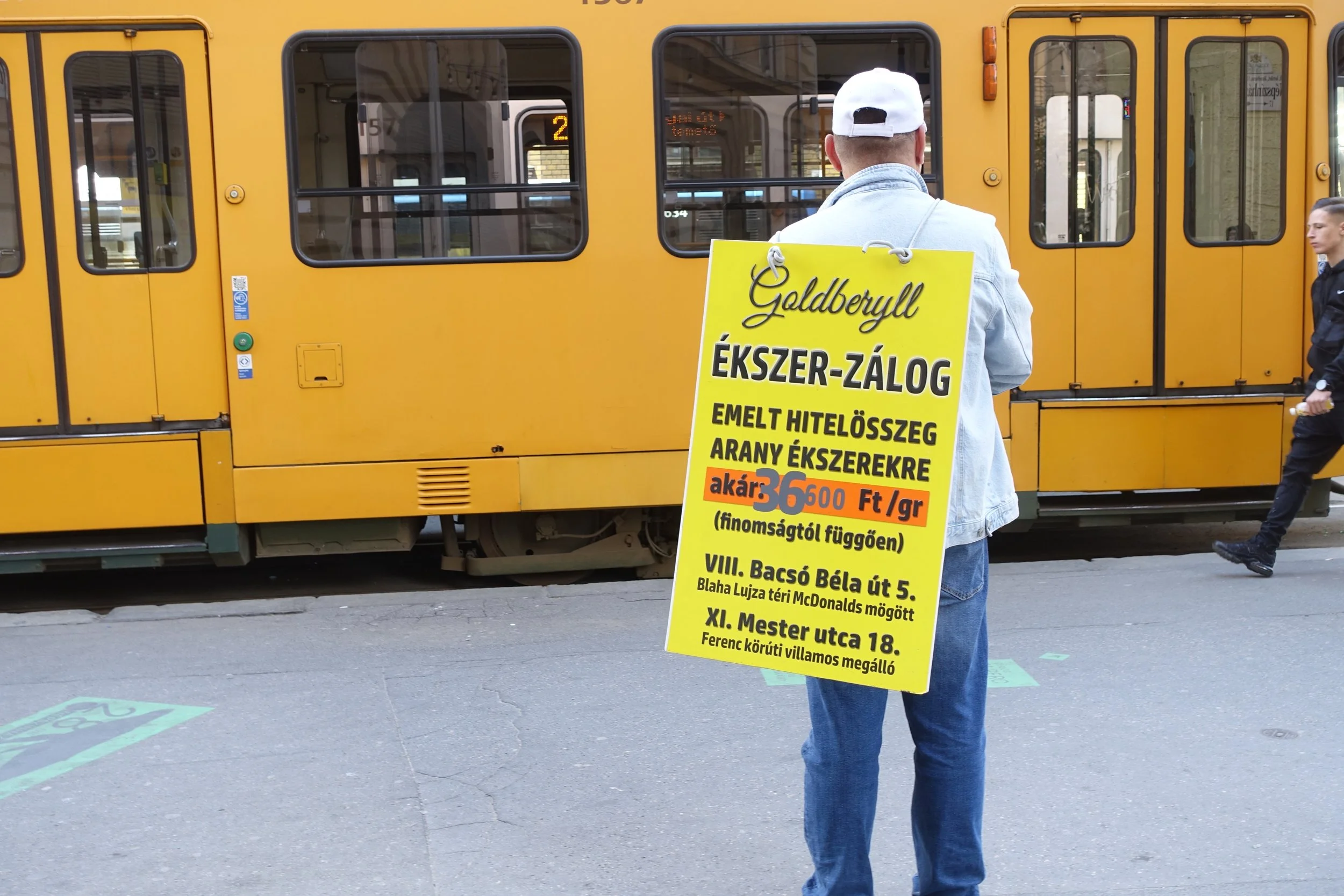
Sandwich board man advertises local Pawnbrokers near Blaha Lujza station.
Right on the junction, at the almost hidden University of Óbuda campus, one can normally enter the building and see an original Ford Model T car in the foyer. It’s located here in memory of an alumnus, the talented József Galamb, Henry Ford’s chief engineer and the man responsible for the design of the world’s first affordable, mass-produced automobile. On this occasion I couldn’t gain access because of building work but it’s an unexpected reminder of the brilliance of twentieth century Hungarian scientists and inventors.
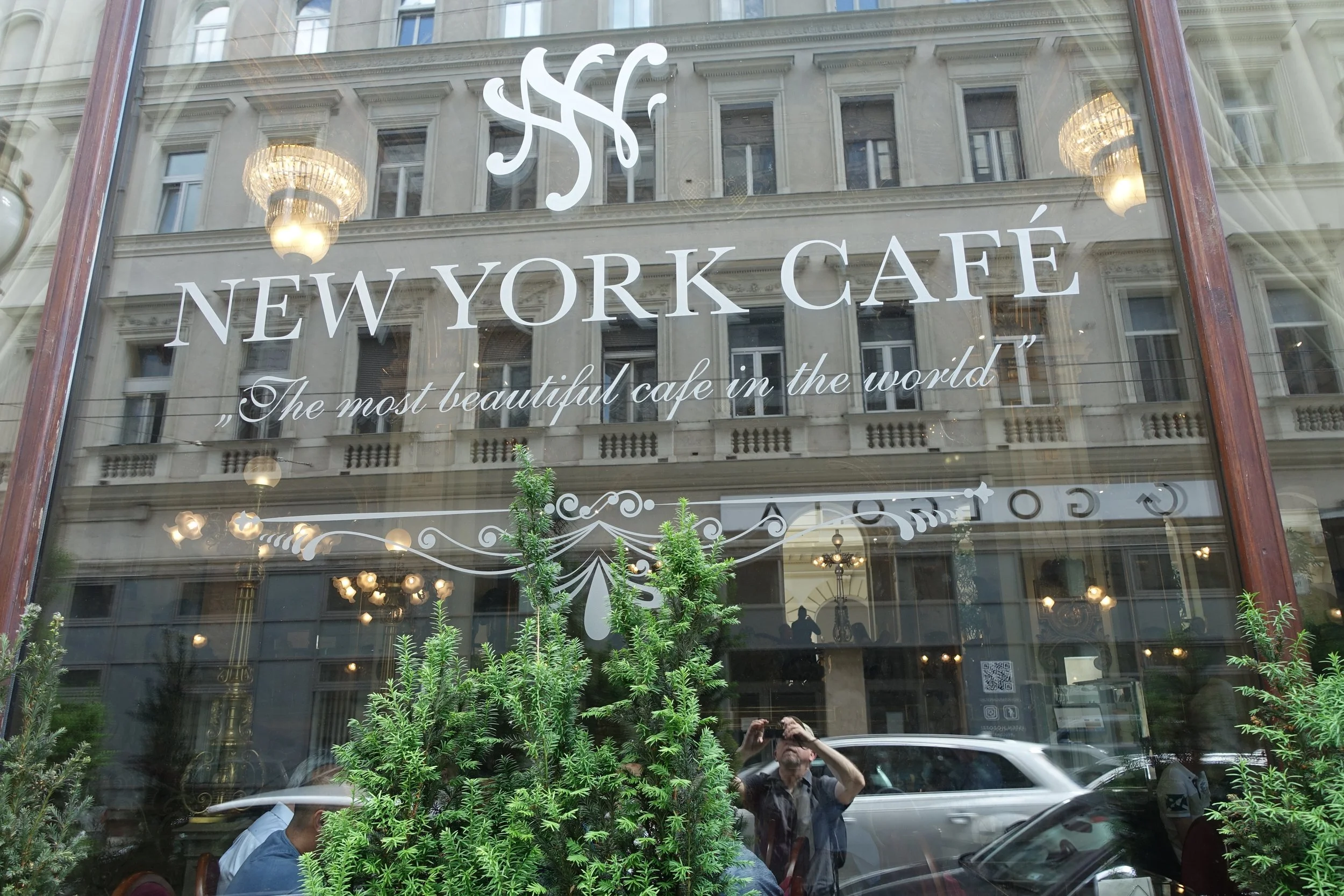
New York Cafe
And as the körút enters ‘Elisabeth Town’, just seventy metres from the ugly Blaha station, one of the most beautiful buildings imaginable rises to host the New York Café. Originally a writer's haunt which opened in 1894, this is one of the big tourist draws in Budapest. I have yet to visit, and people tell me the cakes are better in other cafes still open from that era. But in terms of architectural beauty, this is the jewel in the crown, and it’s easy to see why tourists queue outside throughout the year. We must visit one day, if only to say we have.
District Seven is named after the wife of Emperor Franz Joseph – Elisabeth. Known to Hungarians as ‘Sissy’, she was one of the few members of Habsburg royalty to learn Hungarian and live in the country for extended periods. There are at least five statues around Budapest in her honour, and she is a favourite of the Hungarian people. In terms of beauty, glamour and tragedy, she could be compared to Diana, Princess of Wales. Perhaps it’s fitting then that District Seven is the party centre of Budapest with its bars and night clubs. Only a scattering of visitors take their revelry to the edge of the district, and prices remain lower on the Boulevard, meaning it remains the drinking haunt of Hungarians rather than that of the northern European tribes.
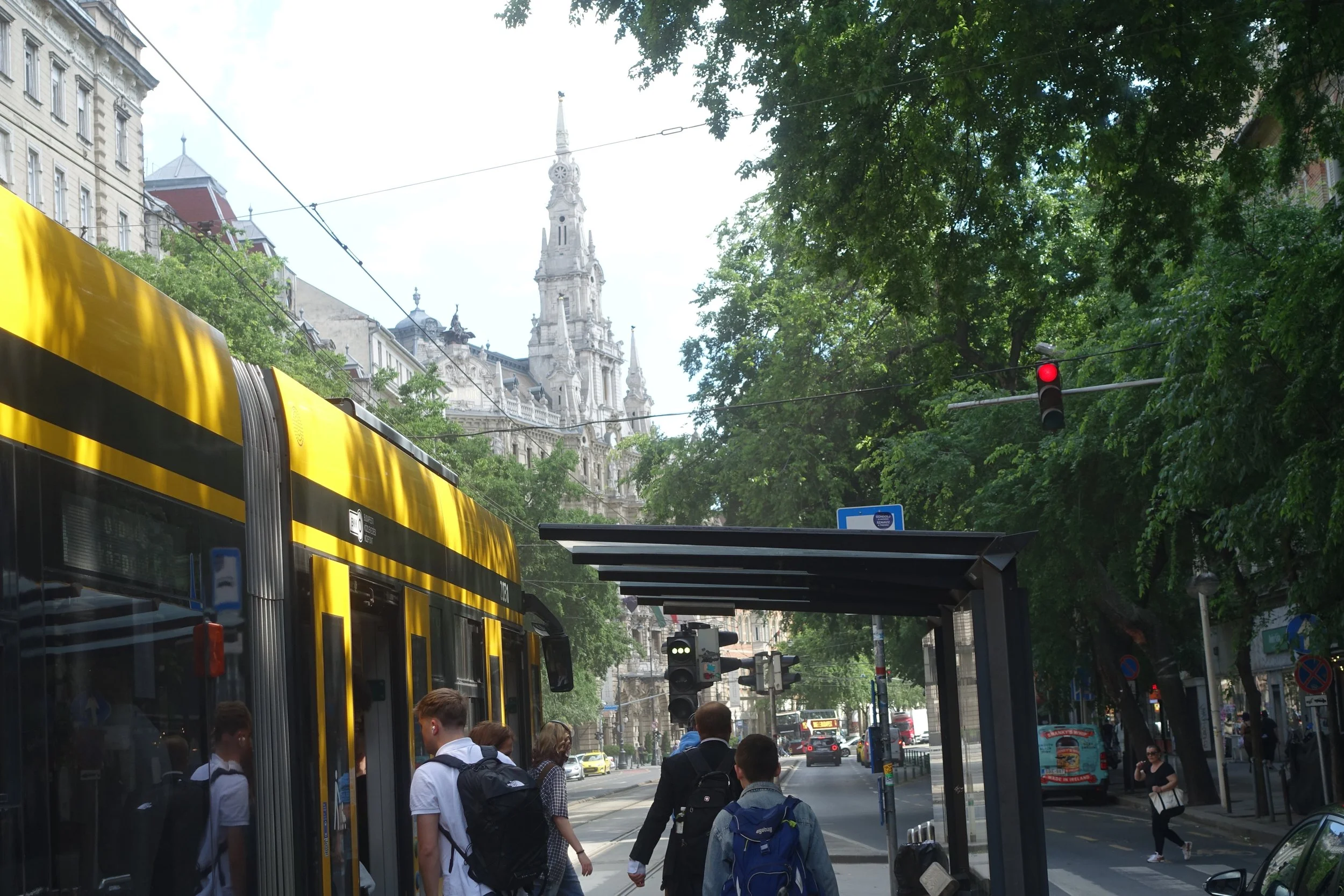
Looking back down Erzsébet körút towards the the Italian renaissance styled, former home of the New York Insurance Company, now housing a hotel above and the New York Cafe on the ground floor.
The part of District Seven ‘inside the Nagykörút’ was also the Jewish quarter and contains the ghetto area from 1944. The area stood dark and sad for the remainder of the twentieth century. The wrecked buildings which opened as Ruin Bars after 2002, often without refurbishment but with much imagination, prompted the creation of the party district. These same buildings where young people from around the world drink and dance the night away once contained crowds of Jewish people forced into crowded rooms and cellars, with the prospect of a journey to Auschwitz awaiting them.
A few sports bars and trendy barbers have drifted out from the party district onto the boulevard itself. I was surprised to encounter premises where all the barbers wore Arsenal shirts celebrating the team’s recent Premier League title success. During my walk I came across several other Arsenal supporters donning the famous red and white colours. Most of whom weren’t Londoners. The Premier League is perhaps the UK’s biggest export – so much for financial services! There are some interesting business premises in the courtyards behind the boulevard, including a fascinating fancy-dress shop. Everything you need for a wild night out can be found in Elisabeth's town.
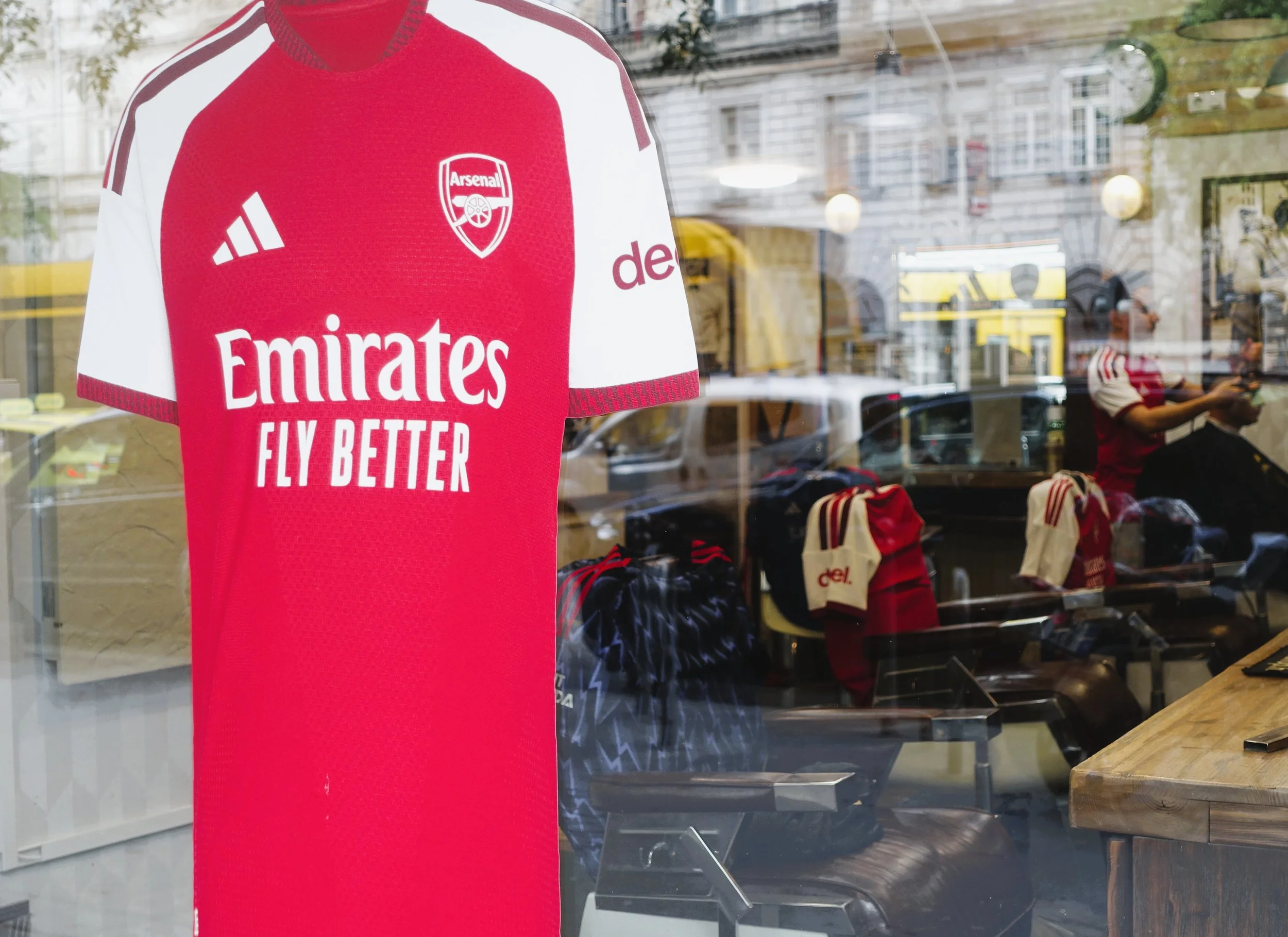
‘Arsenal barbers’ on the edge of the Party District.
Terézváros is the capital’s smallest district but one of the most touristy and affluent, stretching west past the Opera House to the Basilica and east to the City Park. So far, District Six is the only part of the city to ban Airbnb premises from its streets. A trend that is rumoured to spread further in the future. The buildings become noticeably grander along this stretch, with some impressive-looking hotels. There are more tourists strolling the boulevard here, although there are more homeless people as well. Pigeons landed on the arm of one man as he waved his collecting bowl from a horizontal position at the side of the road. I stopped for a cup of tea at the beautiful Artist cinema, where the price was extremely reasonable for the neighbourhood. The nearby Oktagon junction has steps leading down to the Line 1 metro and is crossed by the stylish Andrássy Avenue. Perhaps the city’s most impressive thoroughfare. A Hungarian Champs-Élysées. The infamous ‘Terror House' is two hundred metres away, offering ghastly memories from Hungary’s experiences with totalitarianism.
Beyond the Oktagon, the Teréz körút courtyards are lined with wedding dress shops. The nineteenth-century apartments above are mostly in pristine condition. It’s interesting to note how quiet these residences are despite their close proximity to a main road with four lanes of cars and two tram tracks. The 19th-century builders of Budapest certainly knew what they were doing! There are no pawnbrokers or abandoned hotels along Teréz körút, and your holiday money will be easily spent.
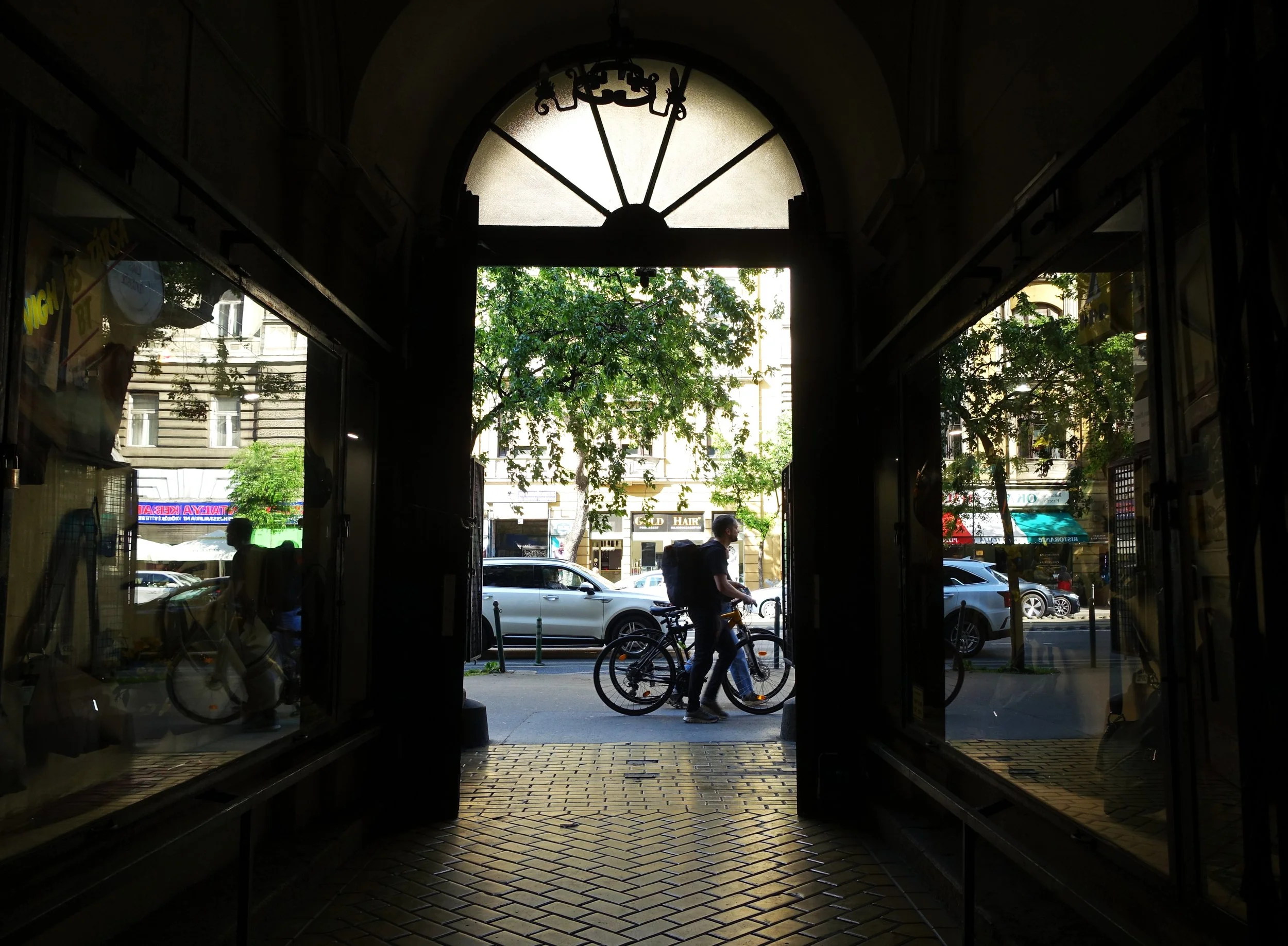
Teréz körút seen from the entrance to a courtyard.
Szent István körút begins just past the intersection with the western railway terminal and metro line 3. St Istvan was instrumental in bringing Christianity to Hungary. Across from the station, a Hari Krishna recruiter attempted to get tourists and locals to join up with him. It was a typically busy workday, and people were too occupied to spare their time. The buildings are even grander along this section, such as the Comedy Theatre, where a play about the 4/6 tram route is currently in the repertoire. I hope the aisles are less crowded than those of the trams at rush hour.
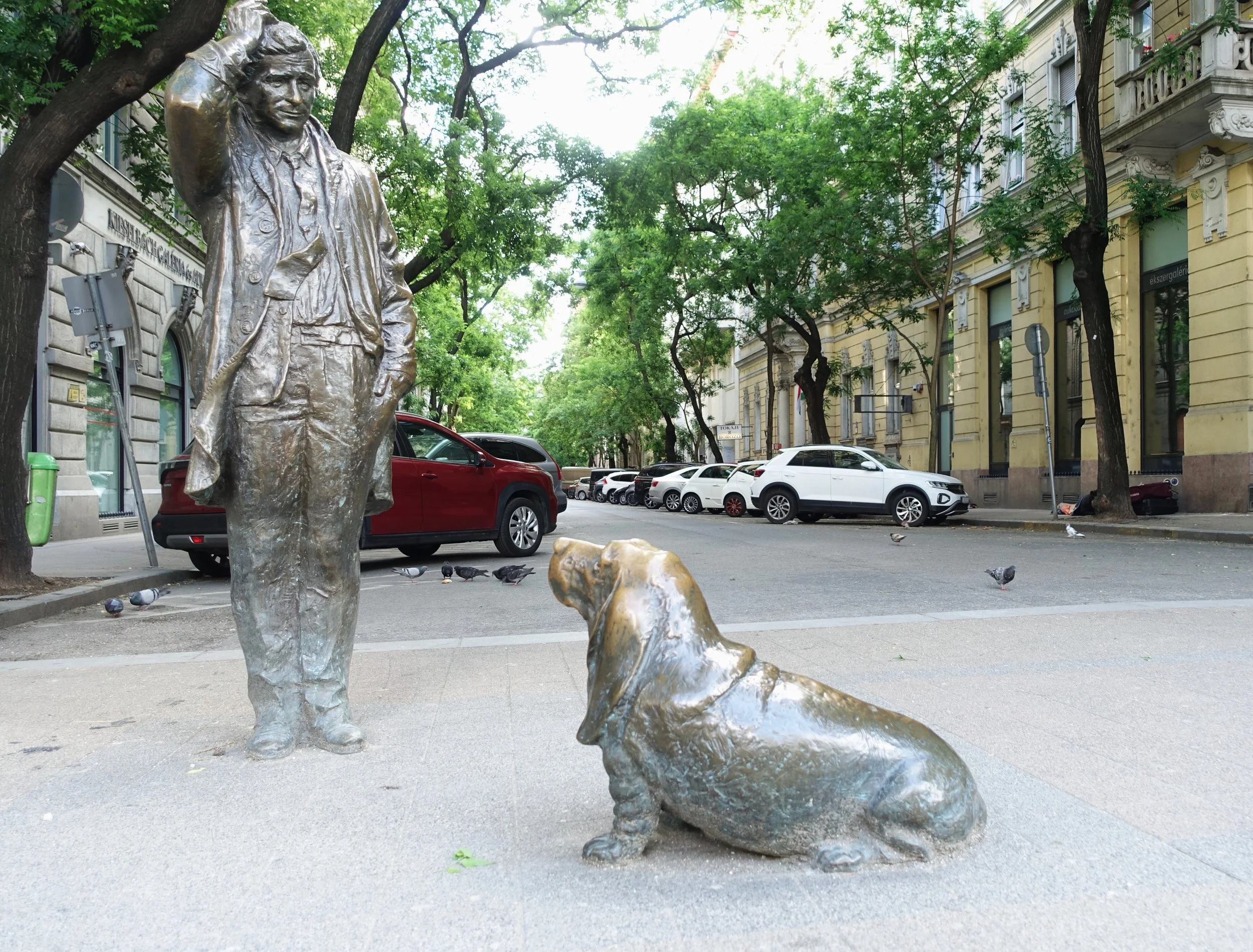
Statue of Peter Falk- star of Colombo with his beloved Basset Hound-known simply as ‘Dog’.
Margaret Bridge was brimming with life and activity. The Parliament area of the city is only a hop, skip and a jump along the riverfront. A statue at Falk Miksa utca celebrates the alleged Hungarian ancestry of the star from Colombo. Tourists and locals throng the tram taking them to Margaret Island, accessible from the middle of the bridge. Budapest felt like an international city rather than the deprived provincial one suggested at the southern end of my walk.
Across the Danube, Margaret körút forms an extension of the boulevard. A once glorious thoroughfare, it became the front line between German and Russian forces in 1945, and many buildings were destroyed. As a result, the architecture is even more varied than on the Pest side. Less historicist and more need-based, the pavements narrower. Buses and trams compete with cars and taxis. For many years this was one of the most polluted roads in the capital and remains clogged with fumes. After ten minutes I could feel an uncomfortable sensation at the back of my throat which wasn’t thirst. The Covid epidemic saw many upmarket shops close here, and few reopened afterwards. The local government has helped to revitalise the area, naming it the Margaret Quarter. Cheap rents have led to entertainment, cultural and environmental groups basing themselves in the former retail outlets, and some lively nightlife venues have opened.
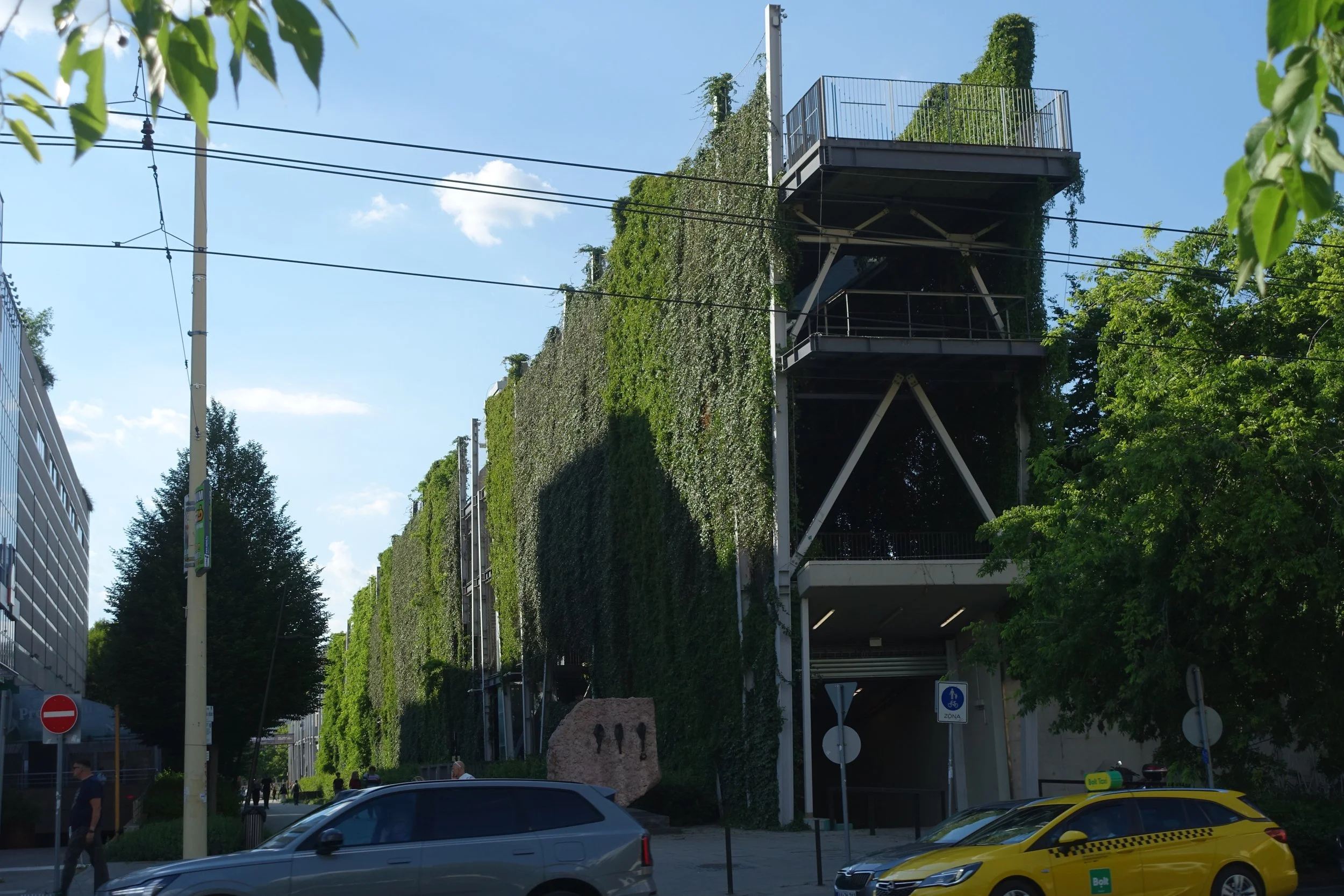
The living wall at Millenáris Park, at the end of the Grand Boulevard.
In 2025, Time Out magazine classified the area as one of the 50 coolest places in the world to visit. Despite excellent venues like the Buda Collection book shop, it’s too noisy and polluted for window shopping. There are fascinating buildings like a two-hundred-and-fifty-year-old Franciscan church and the 1930s Bauhaus and Art Deco designed Atrium Theatre, but on foot it was a relief to reach Széna Square and the completion of the Nagykörút. A gigantic Ganz factory stood in the space now occupied by Millenáris Park. The first electric trains in Europe were built here and tested on overhead walkways which are now planted to form a huge evergreen wall. The front facade of the factory was pulled down and allows breezes to enter from the valley behind it. A desperate attempt to try and refresh Margaret Körút. The final part of the Grand Boulevard is like a slice of inner-city Pest inserted into Buda’s residential heartland. Like a piece of Chicago Deep-Dish pizza slid into a gap in a homely Italian Margherita.
The end of the 4/6 tram line at nearby Széll Kálmán Square remains lively enough, but the international buzz of Pest has faded by this point. The atmosphere is calmer. People are trudging home from work, another day over. Tourists depart on buses to the Castle District, but few find their way in other directions. I am firmly back in Hungary again, deep in the wealthiest corner of the nation.
My stroll began about quarter past twelve and finished at five ten pm, with the two breaks mentioned. I felt surprisingly fresh! Actually, my total walk along the Grand Boulevard was only about three and a half miles long. Even a creaking flâneur like myself should be able to manage that! Seen from the windows of a tram or car, the Nagykörút becomes an extended smear, its details slipping past unnoticed. By contrast, to walk the six districts of the Grand Boulevard is to experience Budapest in miniature and to encounter its spirit on every street corner.
* Comments from Budapest 1900 - by John Lukacs.
** The Secessionist movement in Central Europe was a style of Art Nouveau, impacting all the visual arts.