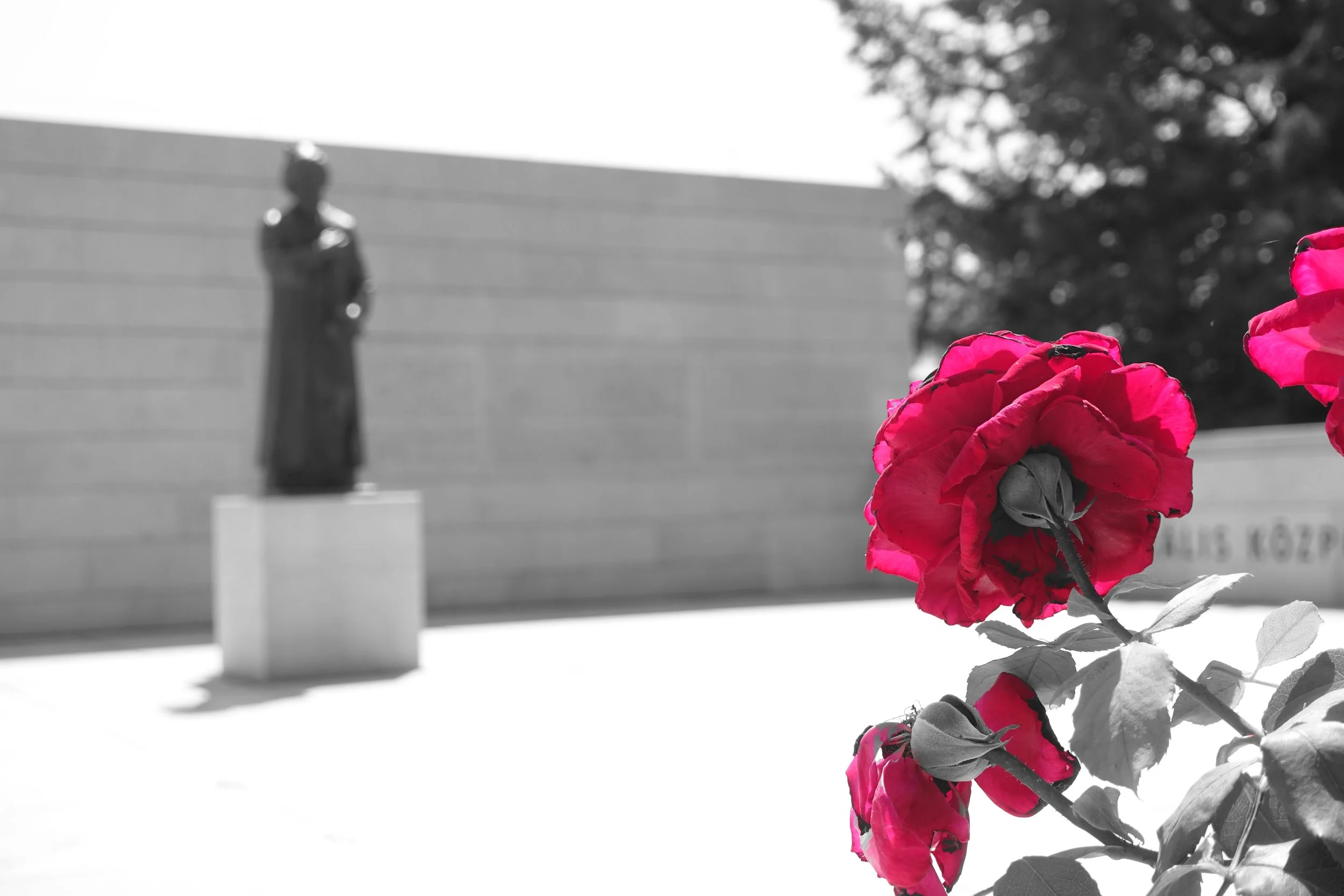
Near the main entrance to Gül Baba’s site.
There isn’t a hipster in sight as I cross the trendy Margaret quarter early on a Sunday morning. It’s too early for any self-respecting Saturday night reveller to be seen recovering with a double macchiato, whatever that might be. In just a few minutes I walk from the tram stop at Margaret Bridge and start to sweat the narrow streets leading up to Rose Hill. An inauspicious open gate on Mescet utca (Mosque Street) provides entry to a staircase bordered with terraced gardens. I step onto territory which was first developed not far off half a millennium ago.
Disrupted from their sun-bathing, tiny lizards run ahead along the walls of the terrace, as though encouraging me to follow them into the past. It’s hard to believe that Buda was a Muslim city for a hundred and forty-five years, and these creatures may be ancestors of those who witnessed the Ottoman conquest of 1541. Difficult to imagine that there were mosques and minarets and the call to prayer echoing around the valleys before the Christian recapture in 1686. While the Ottomans introduced thermal bathing and coffee drinking to Hungary and influenced the development of the Hungarian language, there is little recognition of this in the capital. Not that I think they were responsible for the Iced Caramel Frappuccino, which is all the rage in 2026.
An eagle-eyed visitor might identify the Ottoman-built but currently closed Király bathhouse from 1565. Others might visit the still-open Rudas baths from 1571 and marvel at the architecture. The neighbourhood Törökvész (Turkish blood) in the Buda outskirts was named as such because Ottoman reinforcements during the retaking of Buda in 1686 were defeated in this area. Otherwise, evidence of the Muslim period in Budapest is well hidden. In fact, there are more outward signs of the Roman conquest from the first century AD, like an intact amphitheatre in Óbuda and the ruins of Aquincum, both in the north of the city.
My walk has taken me to a notable exception to this trend. The lizards live in the grounds surrounding the tomb of Gül Baba on Rose Hill, one of Budapest’s most unexpected and beautiful historical locations. It is also the northernmost Islamic pilgrimage site in the world. Gül Baba was a poet and writer and spiritual companion to Sultan Suleiman the Magnificent, who led the Ottomans west. He died in the initial battle for Buda in 1541. Such was his reputation that he became the patron saint of the newly colonised city. He was a member of the Bektáshi Order of Dervishes who approach God by virtues and individual experience rather than by religious scholarship and are closely linked to the Sufi tradition in Islam. Gül Baba translates as the ‘Father of Roses.’
Gül Baba’s tomb and the surrounding Bektás’ ‘lodge’ (monastery) remained standing on a hilly wasteland long after the Habsburg monarchy took control of Hungary after defeating the Ottomans. Gradually the lodge fell into disrepair and then ruin over the centuries which followed. The tomb of Gül Baba was saved initially by being transformed into a Jesuit chapel. Private ownership followed after the Jesuit order was dissolved in 1782. The architect János Wagner purchased the site in 1857, and the tomb remained protected inside the walls of his estate until well into the twentieth century.
Walking through the gardens offers a gentle and pleasant route up to the Tomb. The steep slopes were originally terraced into three gardens by Wagner, and the twenty-first-century renovation has retained them. Interesting, to me anyway. I noticed more roses than lavender in the Lavender Garden. Then more lavender than roses in the Rose Garden. I saw a range of beautiful plants in the Magnolia Garden but little sign of magnolias. Of course, it would have flowered earlier in the year before this rampant blast of sunny June, and I am no expert on magnolias. An ancient well sits at the end of the Lavender Garden, well covered over but once offering water security to the Ottoman occupiers. Throughout the year these little gardens offer tranquillity away from the hustle and bustle near the river. They’re one of my favourite places in Budapest. Let’s hope the hipsters and digital nomads running around below don’t find them.
As I pass into the Islamic-styled courtyard built over the ruins of the Wagner Villa, I am reminded in a random fashion that the singer Cat Stevens converted to become a Sufi Muslim and helped popularise the dervish culture. Seen as a mystical branch of the faith, the Dervishes are closely associated with the whirling dance created by the Mevlevi order from Turkey. Their ceremonial worship is aimed at establishing a closer relationship with Allah. This is sought through abandoning one's self-awareness, ego and personal desires by listening to Sufi music, focusing on God, and spinning one's body in repetitive circles. One explanation of this compares the meditative dance with a symbolic imitation of planets in the solar system orbiting the sun. The Whirling Dervishes are certainly a wondrous sight to behold. Unfortunately, on this shiny June morning there wasn’t one to be seen.
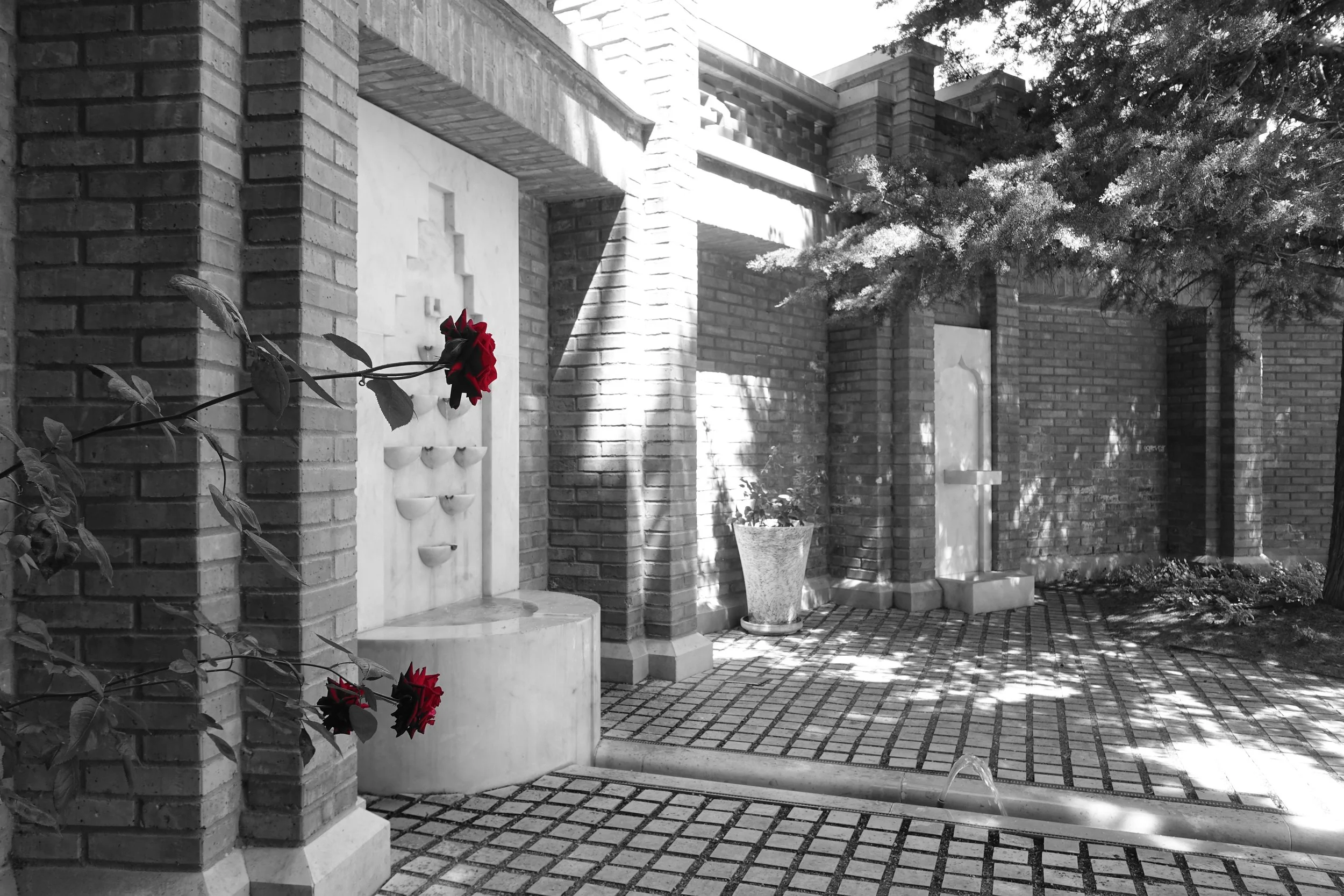
Islamic courtyard
The Wagner Estate survived the First World War, and two Hungarian films were made about Gül Baba in the twentieth century. His reputation as a holy figure was enhanced, and he became seen as a peaceful old man looking after the roses. The reality may have been slightly different. While the Bektashi Dervishes form a mystical branch of Islam with an interest in music, dance and literature, they were also known for their close association with the Janissary corps. The Bektashis were responsible for the spiritual and military education and religious conversion of the Janissaries in the Ottoman Empire. The Janissary was made up of children kidnapped by the expanding Empire and trained into elite fighting troops from a young age. About a quarter of the total Janissary army was made up of kidnapped Christian children.
During the interwar years, relations between Hungary and Turkey improved, and there was growing interest in the Gül Baba site from the Islamic world. This was disrupted by WW2 and then the communist period afterwards. The site came under state control and fell into neglect. After the end of communism and growing relations between Presidents Erdoğan of Turkey and Viktor Orbán of Hungary, an agreement was made in 2017 by which the site was upgraded, with the costs being shared.
While the Wagner Villa was bombed in WW2 and long ago destroyed, the lower floor and cellar area have been converted into an excellent free-to-enter museum which explores the history of Gül Baba. Complete with a café, serving Turkish beverages and a gift shop, this is a small but significant tourist attraction. Well worth a couple of hour’s holiday time for history buffs.
The Tomb of Gül Baba is outside the museum in the Islamic-style courtyard overlooking the city. It is in amazingly good condition considering the destruction that has gone around it over the centuries. Several restorations have of course helped maintain its integrity. The nearby elevated platforms offer excellent views, and the site feels something like a castle. My first visit here was during a changeable February afternoon, and I remember watching the clouds cross the river from the Hungarian plain to deliver thunder, lightning and torrential rain over the Buda Hills. I also visited last January as the snow fell and transformed the cityscape into a timeless canvas of white.
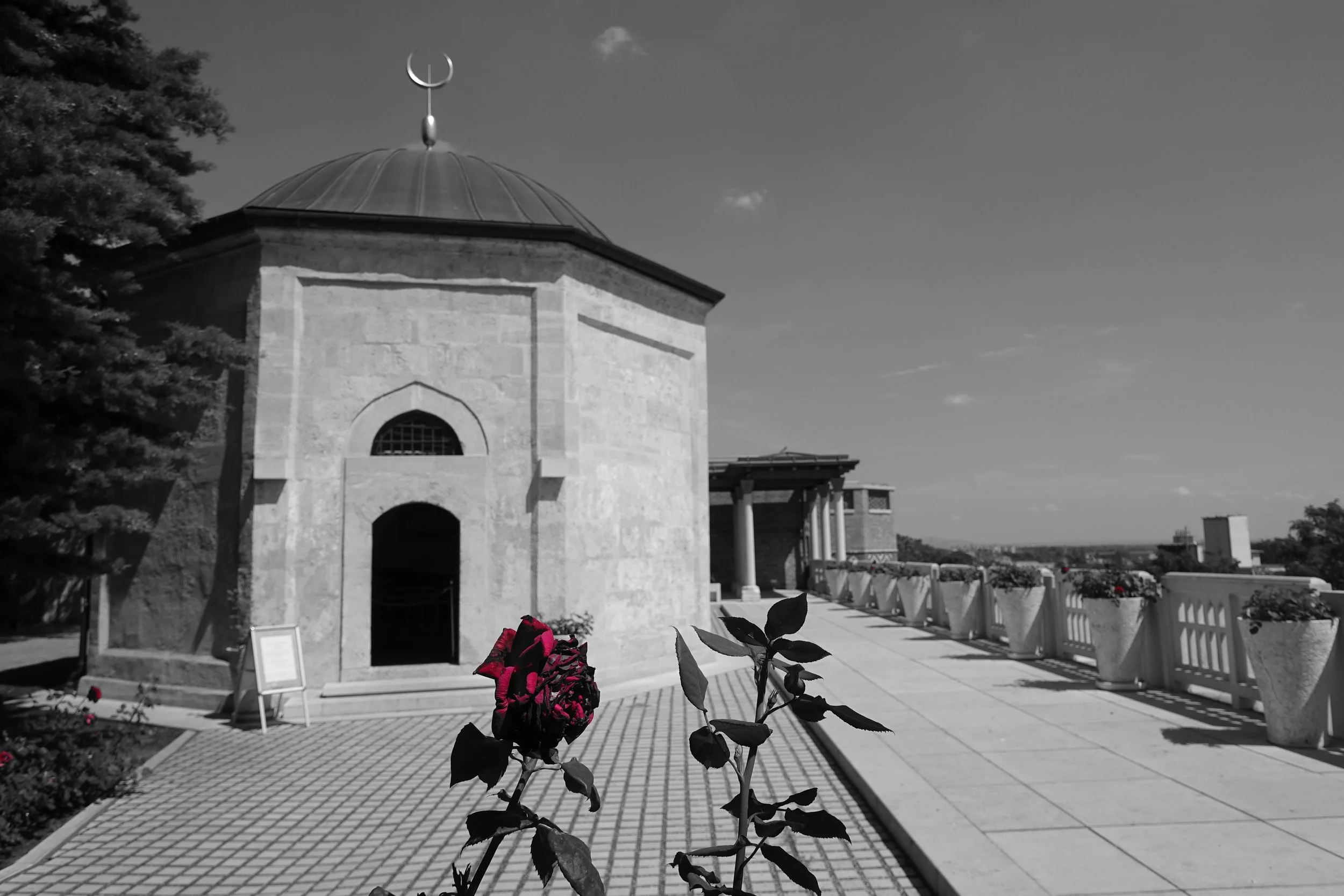
The tomb of Gül Baba
From Gül Baba one can climb a little higher and experience fragments of more recent history. Being Budapest, naturally most of it is tragic. Péter Mansfeld Park is a small hilly space named after the youngest Hungarian to be executed by the Soviet government after the unsuccessful revolution in 1956. He was only fifteen during the uprising and was executed three years later, eleven days after his eighteenth birthday. An interesting piece of modern architecture recalls his memory, and nearby there are more excellent views of the city.
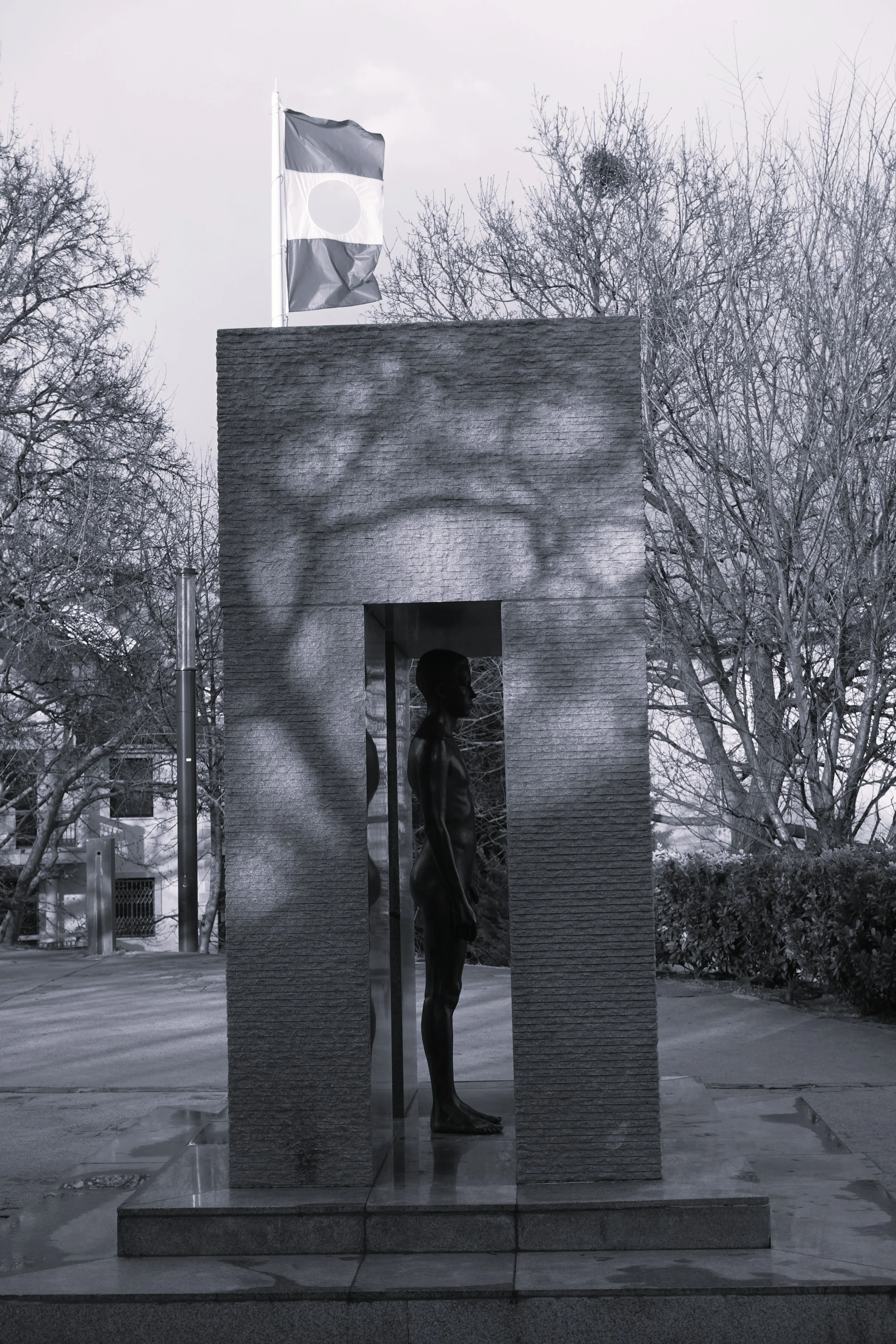
Péter Mansfeld memorial
A two-minute walk north along Apostle utca takes you to the former Neuschloss Villa at number 13. Now, a residential property divided into cheerful apartments, it was bought by the Jewish businessman, Lipót Aschner, in 1934. He made his money from the development of electrical lighting and was a great benefactor. For example, he supplied the funds to build the stadium of the Újpest FC football team in the northern suburbs. A much-renovated building but still standing today.
In 1944 Aschner’s residential property was confiscated by the invading German army, and the logistical organiser of the Holocaust, Adolf Eichmann, made it his Budapest home. Lipót Aschner was imprisoned but managed to survive the war. After organising the Holocaust elsewhere, Eichmann arrived with the occupying forces on the 19th March 1944. Over an eight weeks period, he organised the deportation of four hundred and forty thousand Hungarian Jews from the provinces to Auschwitz. More visible to the world and representing almost a quarter of the city’s population, his genocide was brutal but less successful against the Budapest Jewry.
Eichmann organised most other mass deportations across Europe, but the only evidence that he personally killed anyone emerged in Budapest. It’s alleged that he shot one of his Jewish gardeners at the Neuschloss Villa with a pistol. During his trial in Tel Aviv in 1961, evidence was presented regarding his involvement in this act. The court deemed the evidence to be inconclusive. However, his ignoring of orders from Berlin to halt the expulsions from Budapest to Auschwitz and to stop the death marches west to Vienna was significant in proving the case against him. He was executed in Israel in 1962 as a war criminal. I don’t linger long in Apostle Utca. It’s important to remember the horrors of the past, but I want to keep my mood positive.
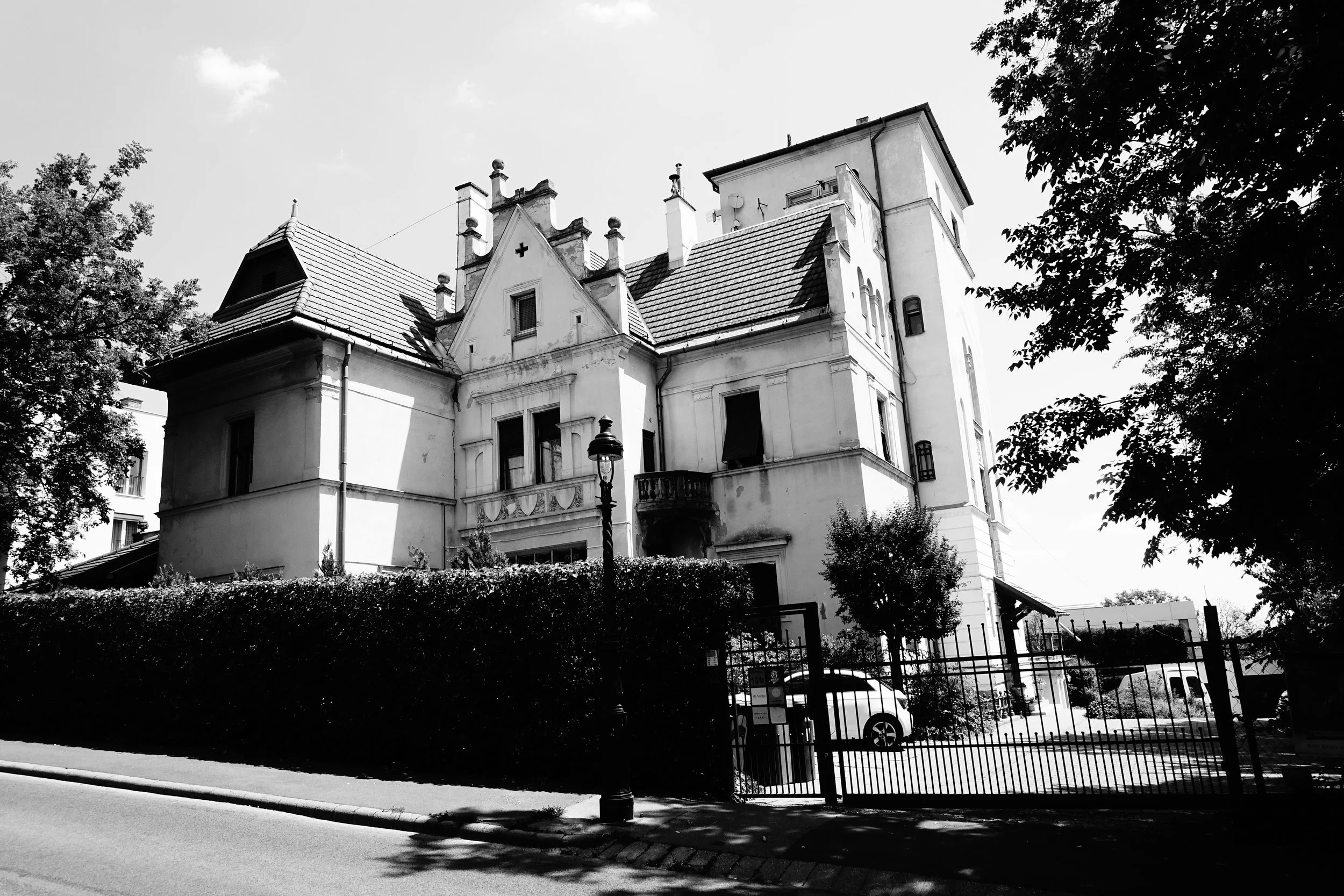
The former Neuschloss Villa
I descended towards the river by way of winding Güll Baba utca, which begins near the renovated tomb area. It’s one of the city’s oldest and most atmospheric streets. Steep and treacherous in icy conditions or heavy rain, with many tiny houses, there is a strong sense of an ancient thoroughfare here. Some buildings have been renovated, and new ones are being built, but traces of the Near East remain in this narrow and ramshackle lane. Something intangible lingered in the air. My imagination was on overdrive, perhaps? Or maybe it was just the dust from buildings crumbling in the sun.
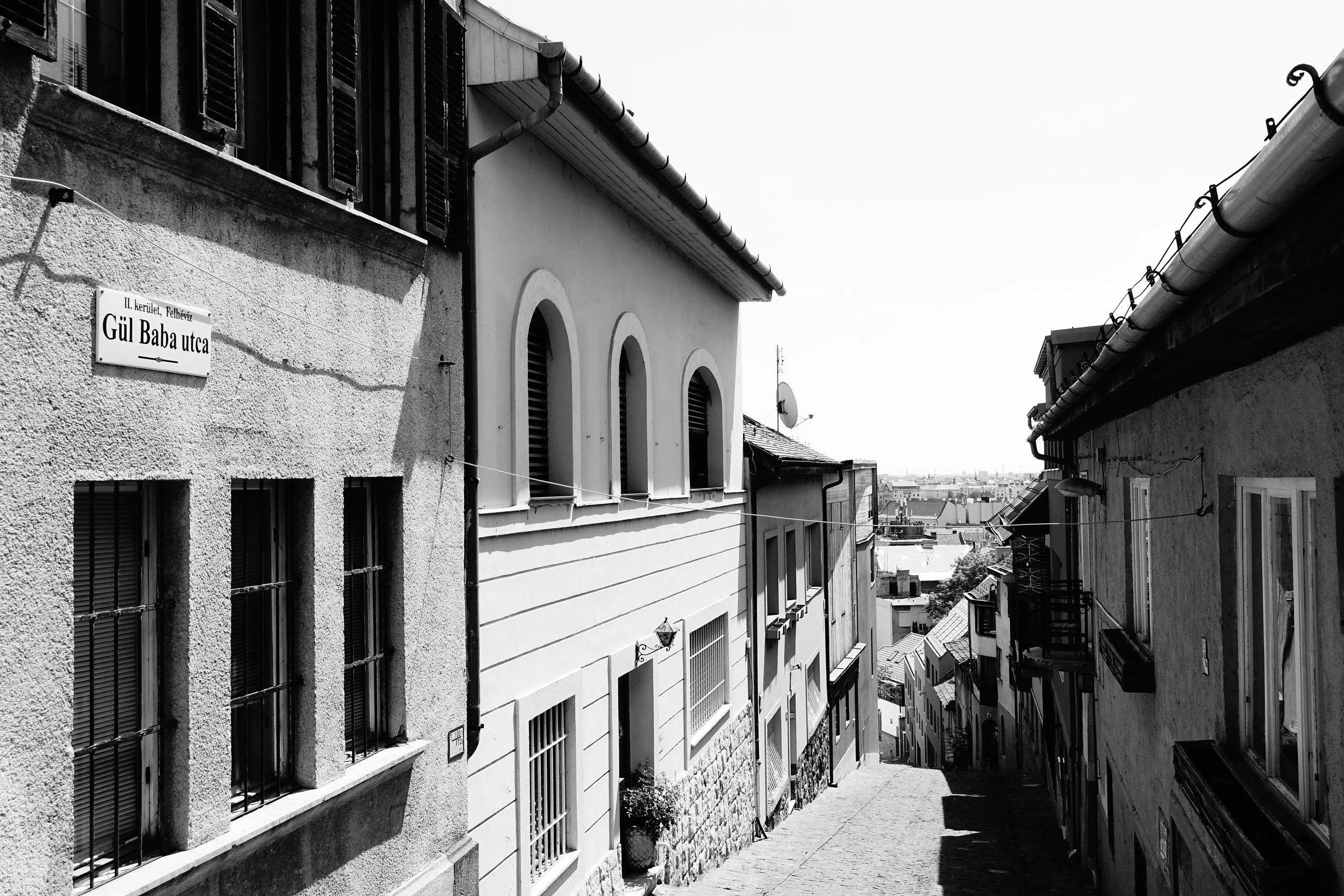
Güll Baba utca
I escaped from the noon heat into a simple café, where I bought a simple cup of mint tea. After visiting the Gül Baba site, I could have looked for some good Turkish espresso. But in this now trendy neighbourhood at the foot of the hill, I would have had to discover what a double macchiato or mocha matcha latte really are. Yes, I know the latter latte is actually black tea. And however delicious said beverages might have turned out to be, they’re tastes of the present I wasn’t ready to savour when those of the past were much more alluring that morning.